The Biggest Missing Step in Database Reactivation: List Triage Before You Send a Single Message
TL;DR: Most database reactivation campaigns underperform not because of the message, the timing, or the channel. They fail because the list was never triaged. Dirty data, misclassified leads, and non-compliant contacts sink results before the first text is sent. Fix the list first. Then write the copy.
Most guides on database reactivation skip straight to the good part: the AI-powered SMS sequence, the conversational tone, the follow-up cadence. All of that matters. But none of it matters if you're sending to the wrong people.
The uncomfortable truth: the list is the campaign. A well-written message sent to a misclassified lead, a reassigned phone number, or a contact who opted out six months ago will not convert. It will bounce, get flagged, or in the worst case, land your business in a TCPA lawsuit during what is already the highest year for TCPA class action filings in history.
The revenue is in your database. That part is true. But the path to it runs through a step almost every business skips: triage.
This article breaks down exactly what list triage looks like, why it is the single biggest predictor of reactivation success, and how to do it before you send message one.
Why Reactivation Campaigns Fail Before Message One
Database reactivation fails when it is treated as a marketing problem. In reality, it is an operational problem. The copy, the AI, the channel, the timing: those are layer three. The foundation is the data.
Contact data decays at roughly 30% per year without active management. A CRM left unmanaged for two years loses more than half its accuracy. That 10,000-contact list you plan to reactivate may have 5,000 reachable, valid records at best, while still costing you full operational overhead for all 10,000.
The numbers are worse than most teams realize:
- 73% of CRM databases suffer from duplicates, outdated information, incomplete records, or invalid data
- 28% of teams never clean their lead data at all
- 50% of contacts that are valid today become invalid within 60 days without maintenance
- Dirty CRM data costs companies an estimated 12% of revenue annually, spread across wasted outreach, failed campaigns, and compliance exposure
The Three Layers of a Broken Reactivation Campaign
Most teams diagnose failure at the wrong layer. They tweak the subject line, change the send time, or swap out the offer. The real problem is almost always upstream.
| Layer | What breaks | What teams actually fix |
|---|---|---|
| Layer 1: Data | Wrong contacts, bad numbers, opted-out leads | Rarely |
| Layer 2: System | Misrouted replies, no handoff process, no suppression logic | Sometimes |
| Layer 3: Message | Copy, tone, offer, timing | Almost always |
The sequence matters. Data problems corrupt targeting. System problems corrupt delivery. Message problems corrupt conversion. Most campaigns never reach the message layer because they were already dead at layer one.
This is why reactivation must be treated as a system, not a promotion. The businesses that see 20-30% reactivation rates are not running better copy. They are running cleaner lists.
What Is List Triage and Why It Comes Before Everything Else
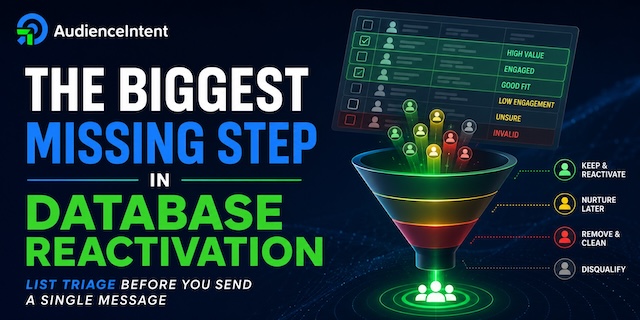
List triage is the process of sorting your database before outreach begins. Not cleaning it in the abstract sense of "removing duplicates," but actively classifying every contact into one of four categories based on reachability, consent status, and conversion potential.
The goal is not to shrink your list. The goal is to stop treating every contact the same. Not all dormant leads went quiet for the same reason, and not all of them belong in the same workflow.
The Four Contact Categories
Key principle: A lead classified incorrectly costs you twice. Once when you waste outreach on the wrong workflow, and again when the non-response or complaint damages your sender reputation or compliance standing.
Category 1: Ready to Reactivate Valid phone number, confirmed TCPA-compliant opt-in, no prior opt-out on record, lead went cold due to timing or follow-up failure rather than disqualification. This is your primary reactivation pool. These contacts should go directly into your SMS sequence.
Category 2: Needs Re-Consent Contact exists in the database but consent was collected through a third-party lead generation form, a co-registration source, or any method that bundled multiple brands in a single opt-in. Under the FCC's January 2026 one-to-one consent rule, consent collected this way is no longer valid for SMS marketing. These contacts require a fresh opt-in before they can be messaged.
Category 3: Do Not Contact Contacts who have previously opted out by any method, including informal requests like "stop texting me" sent via email or voicemail. Since April 2025, businesses must honor opt-out requests made through "any reasonable method," not just STOP keywords. These contacts must be suppressed permanently. Resubscribing them without renewed consent is prohibited.
Category 4: Unworkable Disconnected numbers, reassigned phone numbers (check against the FCC's Reassigned Numbers Database for any number where consent was obtained more than 30 days ago), duplicates, and contacts with no verifiable opt-in record. Remove these before launch.
How to Run the Triage
Running triage is a pre-campaign process, not an ongoing one. It takes time upfront and saves far more time downstream.
- Export your full list from the CRM with all available fields: consent source, opt-in date, opt-out history, last contact date, lead status
- Scrub against the National Do Not Call Registry and your internal suppression list
- Check the Reassigned Numbers Database for any number where consent is more than 30 days old
- Flag third-party consent records collected before January 2026 via lead gen forms that bundled multiple brands
- Validate phone numbers to identify disconnected or reassigned lines before they become bounce events
- Classify each contact into one of the four categories above
- Build separate workflows for Category 1 (immediate outreach) and Category 2 (re-consent sequence), and suppress Categories 3 and 4 entirely
The Compliance Layer: What Changed in 2025 and 2026
TCPA compliance for SMS reactivation became materially more complex in the last 18 months. Teams that built their consent architecture before 2025 are operating under rules that no longer apply.
Here is what changed and what it means for your reactivation list:
April 2025: Consent Revocation by Any Reasonable Method
Before April 2025, businesses could limit opt-out recognition to specific keywords like STOP or UNSUBSCRIBE. That changed. Under the FCC's April 2025 rules, businesses must now honor opt-out requests made through any reasonable method, including emails, voicemails, and informal language like "please stop texting me."
What this means for your list: Any contact who communicated a desire to stop receiving messages through any channel, at any point, must be treated as opted out. If your suppression list only captures keyword replies, it is incomplete. Audit it before launch.
January 2026: One-to-One Consent
The FCC's one-to-one consent rule, which took effect in January 2026, closed the lead generator loophole. Consent collected through a comparison shopping site, a co-registration form, or any lead gen source that bundled multiple brands in a single opt-in is no longer valid for SMS marketing.
What this means for your list: If your database includes contacts sourced from third-party lead generation, those records need re-consent before you can legally send them marketing messages. This is not a technicality. It is a hard line that TCPA plaintiffs' attorneys are already pursuing.
The Reassigned Numbers Risk
Phone numbers get reassigned. A number that belonged to a willing opt-in two years ago may now belong to someone who has never heard of your business. Texting that number is not just a wasted send, it is a potential TCPA violation. The FCC maintains a Reassigned Numbers Database specifically to address this. Check any number where consent was obtained more than 30 days ago.
The risk in plain terms: 2025 was the highest year for TCPA class action filings in recorded history. Sending to a non-compliant list is no longer a minor operational risk. It is a litigation exposure that can dwarf whatever revenue the campaign was supposed to generate.
For a full walkthrough of TCPA requirements specific to SMS reactivation, see AudienceIntent's 2026 TCPA compliance guide for SMS lead reactivation.
What Happens After Triage: Prioritizing the Reactivation Pool
Once you have isolated your Category 1 contacts (valid, consented, reachable), the next mistake is treating them as a single homogenous group. They are not. A lead who requested a quote 45 days ago and went quiet is a fundamentally different conversation than a past customer who bought 18 months ago and has not been contacted since.
Prioritization inside the reactivation pool determines sequence design, message tone, and expected conversion rate.
How to Segment the Reactivation Pool
High-priority: Recent leads with no close Leads who entered the pipeline within the last 6-12 months, showed genuine buying intent (requested a quote, booked a call, visited a pricing page), but were never followed up with consistently. These are the highest-probability contacts in any database. The buying intent was real. The timing just failed. First response speed is still the dominant conversion variable: businesses that respond first win 78% of leads. These contacts deserve the most direct, personal opening message.
Medium-priority: Past customers with a purchase gap Customers who transacted 12-36 months ago but have not returned. They already know and trust the business. The barrier to re-engagement is lower than with cold leads. A conversational check-in with a relevant offer is often enough to restart the relationship.
Lower-priority: Old leads with low engagement history Contacts who entered the database, showed minimal engagement, and went cold quickly. They are worth including in a reactivation sequence but should receive different messaging: softer, more value-led, with lower conversion expectations. Do not run these at the same cadence as high-priority contacts.
The Handoff Problem: What Happens When They Reply
Triage and prioritization solve the front end. The back end is where most campaigns collapse quietly.
A reply is not a conversion. A reply is the start of a conversation that requires a human to close. If your team has no defined process for what happens when a reactivated lead responds, the campaign will generate replies that go nowhere. That is not a technology failure. It is a handoff failure.
Before launch, define:
- Who owns inbound replies and within what timeframe
- What the escalation path looks like for a hot lead versus a question
- How the CRM gets updated when a reactivated contact moves to active pipeline
The businesses generating consistent revenue from reactivation treat it as an operational system with defined ownership at every stage, not a campaign that runs itself. For a deeper look at how this works end to end, see how AudienceIntent turns dormant leads into real revenue.
The Revenue Math: What a Clean List Is Actually Worth
The case for investing time in triage is not abstract. It is a direct revenue calculation.
Consider a database of 5,000 contacts. Without triage, you might send to all 5,000, see a 5-8% response rate from a mixed pool of valid and invalid contacts, and attribute poor results to the message or the channel. With triage, you identify 2,800 truly reachable, consented contacts and send only to them. The same 20-30% reactivation rate that AudienceIntent sees across campaigns now applies to a clean pool, not a diluted one.
The math:
| Scenario | List Size | Reactivation Rate | Revenue Conversations |
|---|---|---|---|
| No triage (raw list) | 5,000 | ~5-8% (diluted by bad data) | 250-400 |
| Post-triage (clean list) | 2,800 | ~20-30% (verified contacts) | 560-840 |
The clean list produces more than double the revenue conversations from fewer contacts. And it does it without the compliance exposure, the wasted send costs, or the sender reputation damage that comes from blasting a dirty list.
The cost of skipping triage is not just missed conversions. A single TCPA class action claim can run into six figures before legal fees. A damaged 10DLC sender reputation can suppress deliverability on future campaigns for months. These are not hypothetical risks. They are the documented outcomes of campaigns that skipped the step.
The revenue is already in your database. Use the Lost Revenue Calculator to see exactly how much is sitting there based on your list size and average transaction value. Then build the triage process that makes it actually recoverable.
Triage Is Not a One-Time Event
One of the most common mistakes after a successful reactivation campaign is treating the triage as done. It is not. Contact data continues to decay at 30% per year. A list that was clean in January is meaningfully less accurate by October.
The businesses that compound their reactivation results over time build triage into their operational rhythm, not just their pre-campaign checklist.
Ongoing List Health: A Practical Schedule
- Monthly: Remove hard bounces, sync opt-out records across all platforms, verify phone numbers for any new contacts added in the prior 30 days
- Quarterly: Full re-verification of active sending list, check for contacts who have gone inactive, re-classify any leads whose status has changed
- Before every campaign: Run against the National DNC Registry, check the Reassigned Numbers Database for numbers older than 30 days, confirm suppression lists are synchronized
This is not a large time investment relative to the cost of skipping it. The teams that never have to rebuild their sender reputation are the ones who never let it degrade.
Bottom line: The biggest missing issue in database reactivation is not the AI, the copy, or the channel. It is the discipline to sort the list before touching any of those things. Triage is the step that makes everything else work. Skip it, and you are not running a reactivation campaign. You are running an expensive guessing game on a database you do not fully understand.
If you want to know exactly what your current database is worth before you invest in cleaning it, run the numbers with the Lost Revenue Calculator. Two minutes. No signup required.
Frequently Asked Questions About Database Reactivation and List Triage
What is list triage in database reactivation?
List triage in database reactivation is the process of classifying every contact in your CRM into actionable categories before outreach begins. The goal is to separate contacts who are ready to reactivate (valid number, confirmed TCPA-compliant opt-in, no prior opt-out) from those who need re-consent, those who must be suppressed, and those who are unworkable due to disconnected or reassigned numbers. Skipping this step is the most common reason reactivation campaigns underperform.
How do I know if my database is TCPA-compliant for SMS reactivation?
Your database is TCPA-compliant for SMS reactivation if every contact you plan to message has a documented, dated opt-in that names your specific business, has not subsequently opted out through any channel, and was not sourced through a third-party lead generation form that bundled multiple brands in a single opt-in. Under the FCC's January 2026 one-to-one consent rule, bundled third-party consent is no longer valid for SMS marketing. If you cannot verify the consent source for a contact, treat that record as requiring re-consent before sending.
How old is too old for a lead to reactivate?
There is no universal cutoff, but consent status and original intent matter more than age alone. A lead from 18 months ago with documented opt-in, a known source, and a clear buying signal is worth a reactivation attempt. A three-year-old record with no provable consent, one cold touch, and no engagement history carries more risk than potential. The practical rule: if you cannot confirm documented, dated consent still on file, win it again before you send.
What happens to contacts who previously opted out informally?
Since April 2025, businesses must honor opt-out requests made through any reasonable method, not just STOP keywords. That includes emails, voicemails, and informal language like "please stop texting me." Any contact who communicated a desire to stop receiving messages through any channel must be permanently suppressed. If your suppression list only captures keyword replies, it is incomplete and needs to be audited before any campaign launches.
What reactivation rate should I expect from a clean, triaged list?
AudienceIntent sees 20-30% reactivation rates across campaigns run against properly triaged lists of TCPA-compliant, opted-in contacts. Results vary by industry, list age, and offer relevance. A raw, untriaged list will typically produce 5-8% response rates at best, diluted by bad numbers, opted-out contacts, and misclassified leads. The difference is not the message. It is the quality of the list the message goes to.
Recover What's Yours. Own What's Next.
Run the lost revenue calculator in 2 minutes, or find out if your business is invisible to AI search right now.