
AI Search Is Now the Highest-Converting Channel in Shopping. Here Is What That Means for Your Business.

Key Takeaways
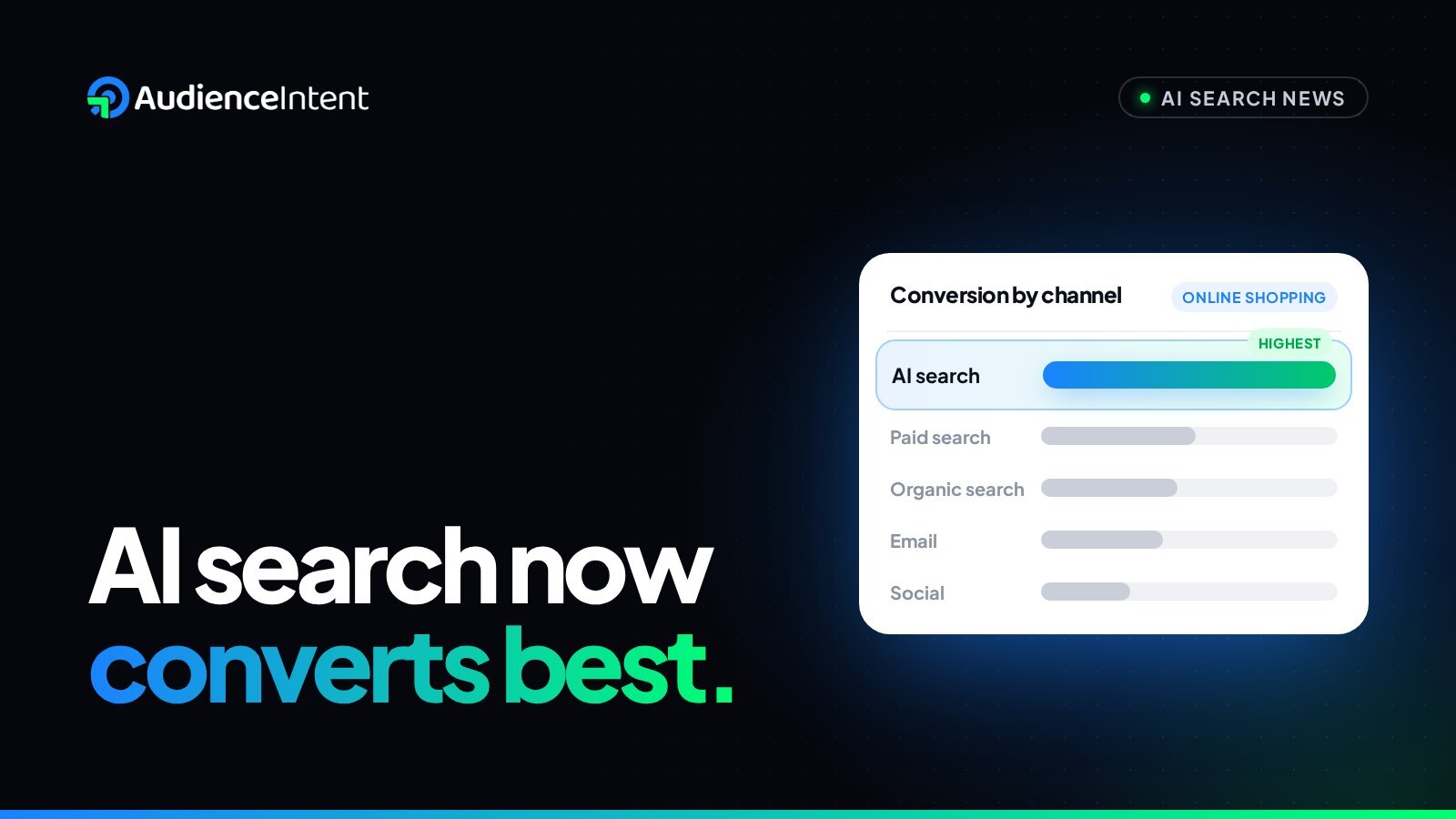
- Shoppers arriving from ChatGPT, Perplexity, and Google AI converted 68% better than all other traffic on Black Friday 2026, up from 38% better in 2025. (Adobe Analytics)
- AI-influenced sales accounted for $262 billion, or 20% of all global holiday purchases, in the 2025 season. (Salesforce)
- Adobe tracked AI traffic every quarter in 2026. The conversion advantage grew every single month, from 42% better in Q1 to 68% better by Black Friday.
- Most AI-assisted purchases are invisible to analytics: shoppers research on ChatGPT, then navigate directly to the site to buy.
- Adobe forecasts 130% growth in AI-referred retail traffic for the 2026 holiday season. The window to be the business that gets recommended is open now.
On Black Friday 2026, shoppers who arrived from an AI tool converted 68% better than everyone else and were 61% more likely to add items to their cart. That is not a one-off. It is the latest point in a trend that has grown every single month for over a year, backed by Adobe Analytics data covering more than one trillion visits to U.S. retail sites.
The businesses showing up in those AI answers are capturing the most motivated buyers on the internet. The ones that are not are invisible to those buyers at the exact moment they are ready to spend.
Here is what the data actually shows, why the real impact is larger than any analytics dashboard reveals, and what a business owner should do about it.
The Numbers: A Two-Year Story
The 2025 holiday season was the first time AI-referred shoppers outperformed every other traffic channel. Black Friday 2026 confirmed it was not a one-off. The gap has grown every single month in between.
Black Friday 2025 vs. Black Friday 2026
| Metric | Black Friday 2025 | Black Friday 2026 |
|---|---|---|
| Conversion rate vs. non-AI traffic | +38% better | +68% better |
| AI traffic growth year over year | +805% | +100% (on a much larger base) |
| Add to cart vs. non-AI traffic | Not tracked | +61% more likely |
| Online sales that day | $11.8 billion | $13.1 billion |
Sources: Adobe Analytics holiday recap (January 2026) and Adobe Black Friday 2026 final figures (November 2026).
The 805% growth figure from 2025 was coming off a small base. The 100% growth in 2026 is arguably more significant: AI-referred traffic doubled again on top of an already large number, and the conversion advantage widened at the same time.
Every month in 2026, a new record
Adobe published quarterly AI traffic reports throughout 2026. The pattern is consistent across every one.
- Q1 2026: AI traffic converted 42% better than non-AI. A year earlier it had converted at nearly half the rate. (Adobe Q1 2026 report)
- Q2 2026: Conversion advantage grew to 54% better. Revenue per visit 53% higher.
- Q3 2026: Conversion advantage hit 60% better. Bounce rate 34% lower. (Adobe August 2026 report)
- Black Friday 2026: Conversion advantage reached 68%. Eleven straight months of AI outperforming every other channel.
Shoppers arriving from AI tools are not browsing. They arrive with a shortlist already formed and a decision nearly made.
What Salesforce found across the full 2025 season
Salesforce's 2025 holiday data covered the full November through December period and found that AI and agents influenced $262 billion in global retail sales, accounting for 20% of all holiday purchases. Shoppers referred from AI search channels converted nine times more often than those coming through social media.
That last number is worth sitting with. Social media has absorbed the majority of marketing budgets for over a decade. AI search, which most businesses have barely thought about, is already outperforming it by a factor of nine on conversion.
For the 2026 holiday season, Salesforce forecasts that AI and agents will influence $75.8 billion in Cyber Week sales alone, with AI-driven traffic to retailer websites up 104% year over year.
Why the Real Impact Is Bigger Than the Data Shows
Here is the catch: the numbers above almost certainly undercount AI's true influence on purchasing decisions.
Adobe measures AI traffic by counting clicks from an AI tool directly to a retail site. That is a clean, trackable signal. But it captures only one version of how AI-assisted shopping actually works.
The journey your analytics cannot see
The more common path looks like this:
- A shopper asks ChatGPT or Perplexity which product to buy, which brand to trust, or where to find the best deal.
- They get a recommendation with a name, a reason, and sometimes a link.
- They close the chat, open a new tab, and search for that brand directly, or type the URL from memory.
- They land on the site and buy. Their session is recorded as direct traffic or organic search.
That last step is invisible to attribution tools. The AI did the convincing. The credit went elsewhere.
The attribution blind spot: Most analytics platforms only capture the final click before purchase. When an AI recommendation shapes the decision but the shopper navigates directly to the site afterward, that sale appears as direct traffic or organic search. The AI's role disappears entirely from the data.
The 805% growth in AI-referred traffic during Black Friday 2025 represents only shoppers who clicked a link directly from within the AI tool. The full population of people whose buying decisions were shaped by an AI recommendation is substantially larger.
The verification gap confirms this
Adobe's 2026 consumer research found that 50% of shoppers who use AI for online shopping click the links provided by the AI assistant. But 86% of those who used AI for product research also verified the recommendation through another source before buying, according to MarTech's 2026 AI shopping analysis.
That verification step, whether it is a Google search, a direct visit, or a review site check, is what makes AI influence so hard to measure. The AI shaped the decision. The last click before checkout got the attribution.
If your business shows up confidently in AI answers, you are influencing purchases that your analytics will never fully credit. If you do not show up, you are losing customers you never knew were available.
This Is Not Just a Retail Story
It is easy to read Black Friday data and assume this only applies to ecommerce companies selling electronics and toys. The behavior driving it is much broader.
The same instinct that sends a shopper to ask "what's the best TV deal right now?" also sends someone to ask "which HVAC company should I call in Phoenix?" or "what's the best law firm for a small business contract dispute?" The questions are different. The behavior is identical.
According to L.E.K. Consulting's 2026 research, 46% of AI users now start their purchase research on a standalone AI platform like ChatGPT, Gemini, Perplexity, or Claude, up from 25% in 2024. Traditional search dropped from 43% to 24% over the same period. That is a seismic shift in where buying decisions begin, and it applies to every category where someone researches before spending.
Where AI-assisted research is growing fastest
Adobe's 2026 data shows AI-referred traffic growing across every industry it tracks:
| Industry | AI traffic growth (2026) |
|---|---|
| Retail | +62% year over year (July 2026) |
| Travel | +119% year over year (July 2026) |
| Financial Services | +31% year over year (July 2026) |
Source: Adobe AI Traffic Trends Report, August 2026.
Travel covers hotels, tour operators, and local experiences. Financial services covers insurance, accounting, and professional advice. The pattern playing out in retail is playing out everywhere people make considered decisions before spending money.
For service businesses, the stakes are arguably higher. A shopper who buys the wrong TV can return it. A homeowner who hires the wrong contractor, or a business owner who picks the wrong accountant, faces a much harder situation. That makes the research phase more important, not less, and AI tools are where that research increasingly starts.
The businesses that get named in those answers are already winning customers their competitors never knew were available.
What to Do With This Information
Adobe is forecasting 130% growth in AI-referred retail traffic for the full 2026 holiday season, with Thanksgiving up 159%, Black Friday up 95%, and Cyber Monday up 88%. That forecast was published in September 2026. Black Friday 2026 data confirmed the trend is running on schedule.
The businesses that benefit most from this shift are not the ones with the biggest ad budgets. They are the ones that AI tools know enough about to recommend with confidence. That comes down to four things:
- Clear, consistent business information across the web, so AI tools can describe you accurately when someone asks.
- Content that answers real questions, so when a relevant question gets asked, your business shows up in the answer.
- Third-party signals such as reviews, citations, and mentions that give AI tools reason to trust the recommendation.
- Accurate details on Google, directories, and social profiles, which AI tools draw on when building their answers.
None of this requires a large team or a complicated strategy. It requires focus, consistency, and someone who understands how AI tools decide what to recommend.
Most businesses have not started yet. That is the opportunity. The window to build a meaningful advantage before competitors catch up is still open, but it is getting narrower every quarter.
If you want to see where your business currently stands right now, AudienceIntent's free AI visibility check shows how you appear across ChatGPT, Google AI, and Perplexity. It takes about two minutes and shows you exactly where the gaps are.
The holiday shopping data from 2025 and 2026 is a preview of how all buying decisions are moving. The businesses that act on it now will be the ones their competitors are trying to catch up with next year.
Frequently Asked Questions
How much did AI-referred shoppers outperform other channels on Black Friday 2026?
Shoppers arriving from AI tools converted 68% better than visitors from other channels on Black Friday 2026, and were 61% more likely to add items to their cart. That is up from 38% better on Black Friday 2025, according to Adobe Analytics.
Did AI shopping behavior start with the 2025 holiday season?
The 2025 holiday season was the first time AI-referred traffic moved from lagging other channels to leading them. But the trend has continued every month since. Adobe's quarterly reports show the conversion advantage growing from 42% in Q1 2026 to 68% by Black Friday 2026.
Why does my analytics not show AI as a major traffic source?
Most analytics platforms only track the final click before a purchase. When a shopper gets a recommendation from ChatGPT and then navigates directly to the site, that visit is recorded as direct or organic traffic. The AI's role disappears from the data entirely, which means the measurable figures almost certainly undercount AI's true influence.
Does this only apply to ecommerce businesses?
No. The same research behavior driving AI-assisted product purchases is driving how people choose service providers, contractors, law firms, and local businesses. L.E.K. Consulting's 2026 data shows 46% of AI users now start their purchase research on a standalone AI platform, across categories well beyond retail.
What makes a business show up in AI recommendations?
AI tools recommend businesses they can describe accurately and confidently. That requires consistent information across the web, content that answers the questions your customers actually ask, third-party signals like reviews and citations, and accurate business details on Google and major directories.
Want this done for you?
We get your business recommended by AI. See the weekly report our clients get, or book a call.