
ChatGPT Just Launched Business Hub. Here's What It Means for How Customers Find You.

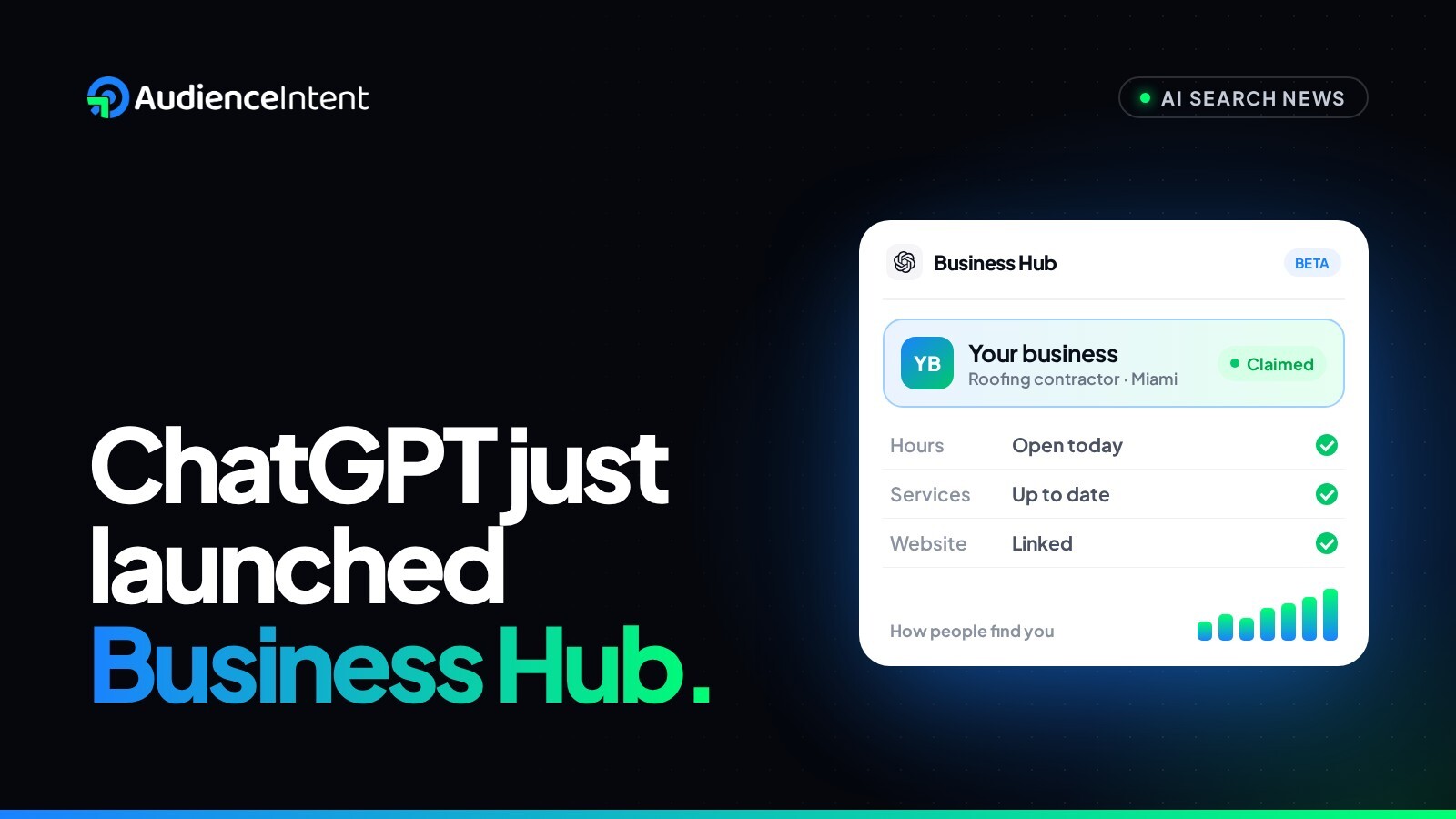
On November 10, 2026, OpenAI announced Businesses in ChatGPT, a new feature that lets any business owner claim their business directly inside ChatGPT, update their information, and see how many times ChatGPT has mentioned or linked to them.
That last part is the one worth paying attention to.
For years, the question business owners asked was: "How do I show up on Google?" That question is changing. Customers are now asking ChatGPT who to hire, where to eat, which product to buy, and which company to trust. ChatGPT now has 1.2 billion weekly users making exactly those kinds of decisions inside the platform every day.
Business Hub is OpenAI's signal that ChatGPT is no longer just a chatbot. It's a search channel.
If you're not showing up there, you're invisible to a growing share of your market. And until now, you had no way of even knowing it.
What Business Hub Actually Does
Business Hub is a dashboard inside ChatGPT where business owners can claim their listing, manage their information, and track how the platform talks about them. Think of it like Google Business Profile, but for the world's most widely used AI platform.
Here's what you get once your claim is verified:
- Claim your listing. Search for your business inside ChatGPT, verify ownership via phone, email, or DNS, and take control of how your business is represented.
- Update your information. Edit your website, business description, category, logo, and more. For product-based businesses, you can connect a product feed with live pricing and availability.
- See your mentions and clicks. Business Hub shows aggregated data on how often ChatGPT mentions your business and how many people click through to your website. These are rolling 28-day figures.
- Explore discovery topics. See the common themes in conversations where your business was cited. This tells you what questions are driving people to find you, even if you can't see the individual conversations.
- Build a Business Agent (ecommerce and online services only, US). Eligible businesses can create an AI agent that lives on their ChatGPT profile. When ChatGPT recommends your business, customers can click through and ask your agent questions directly.
What the Mentions Number Actually Means
This is worth a moment. OpenAI is careful about how it defines a "mention."
For an online business, a mention counts when ChatGPT references your website in a response. Your brand name appearing in text without a link does not count. For a local business, a mention counts when ChatGPT shows your location in a result, even if the customer doesn't click through.
That means the numbers you see in Business Hub are conservative. The real number of times ChatGPT talks about your business is almost certainly higher.
Why This Is a Bigger Deal Than It Looks
Most of the coverage around Business Hub has focused on the feature itself: claim your profile, see some stats, maybe build a chatbot. That framing misses the bigger story.
OpenAI just built the infrastructure for ChatGPT to function as a business directory. That's not a small product update. That's a structural shift in how people find and choose businesses.
The Google Business Profile Parallel
When Google launched Google Business Profile (then called Google My Business), plenty of business owners shrugged. It seemed like a minor thing: add your address, your hours, a few photos. Within a few years, it became one of the most important factors in local search visibility. Businesses that claimed and maintained their profiles showed up. Businesses that ignored it didn't.
Business Hub is the same moment, on a platform growing faster than Google Search ever did.
"We're introducing Businesses in ChatGPT in beta, giving businesses a new way to connect with the 1.2 billion people who use ChatGPT each week." — OpenAI, November 10, 2026
The Search Behavior Has Already Changed
Here's the part that should matter to any business owner: the shift in customer behavior isn't coming. It's already here.
People are asking ChatGPT questions like:
- "What's the best HVAC company near me?"
- "Which law firm handles employment cases in Dallas?"
- "Find me a reliable roofer with good reviews."
- "What's a good food tour in Nashville?"
These aren't hypothetical. These are the kinds of prompts that are generating mentions and website clicks for businesses right now, before Business Hub even existed. The difference is that until this week, you had no way to see it happening.
Business Hub doesn't change how ChatGPT recommends businesses. It just finally lets you see that it already is.
That visibility gap is the real problem. If your competitors claim their profiles before you do, they get the data. They learn which topics drive their mentions. They update their information to match what ChatGPT is pulling. They get the head start.
What This Means for AI Search More Broadly
Business Hub doesn't exist in isolation. It's part of a broader pattern playing out across every major AI platform.
Google AI Overviews now appear at the top of millions of search results, pulling answers directly from the web and citing specific businesses and sources. Perplexity surfaces product recommendations, local businesses, and service providers in response to everyday questions. ChatGPT, with Business Hub, is now formalizing the same behavior.
The three platforms your customers use most are all moving in the same direction: toward answers, not links.
The Old Model vs. the New One
| Old Search Model | AI Search Model |
|---|---|
| Customer types a query | Customer asks a question |
| Gets a list of 10 blue links | Gets a direct answer with 1-3 cited sources |
| Clicks through to compare options | Often decides based on the answer alone |
| Your ranking depends on keywords | Your recommendation depends on trust signals and content |
| You measure clicks and impressions | You measure mentions and citations |
The practical implication: being on page one of Google still matters. But it's no longer enough on its own. A business that ranks well on Google but isn't being recommended by ChatGPT, Google AI, or Perplexity is losing ground to businesses that show up in both places.
Claiming Your Profile Is Step One, Not the Whole Game
This is where Business Hub can mislead people into thinking they've done the work.
Claiming your profile and updating your information gives ChatGPT accurate data about your business. That's useful. But it doesn't cause ChatGPT to recommend you. The recommendation decisions are still driven by what ChatGPT knows about your business from across the web: your website content, your reviews, how other sources describe you, how well you answer the questions your customers are actually asking.
Filling out a profile won't make you recommended. But it will help you understand whether you already are, and where the gaps are.
That's the real value of the mentions and discovery topics data. It tells you which questions are driving your visibility, so you can build more content and signals around those themes.
What to Do Right Now
Here's a practical checklist for any business owner reading this today.
Claim Your Business in ChatGPT
- Go to ChatGPT Business Hub and sign in with your ChatGPT account.
- Search for your business name and select your listing.
- Verify ownership via phone, business email, website domain, or DNS.
- Complete identity verification through Persona (required to publish changes and view insights).
- Update your business description, category, website, and logo.
- If you sell products, connect your product feed.
Once your claim is approved, check your Insights dashboard. Look at your mentions, website clicks, and discovery topics. Even if the numbers are low right now, the data will tell you where you stand.
Beyond the Profile: What Actually Moves the Needle
Claiming your profile is the starting point. Getting recommended consistently requires a different kind of work:
- Answer the questions your customers are asking. ChatGPT pulls from your website content. If your site doesn't clearly answer "what does \[your business\] do and why should I choose you?", ChatGPT can't confidently recommend you.
- Build your authority across the web. Reviews, press mentions, directory listings, and third-party citations all feed into how AI platforms assess your credibility.
- Keep your content fresh. Google and ChatGPT both weight recency. A page that hasn't been updated in 18 months loses ground to one that was updated last month.
- Track your visibility across all three platforms. ChatGPT, Google AI, and Perplexity all behave differently. A mention on one doesn't guarantee a mention on the others.
The businesses winning in AI search right now are the ones who started treating it as a real channel six months ago. The ones who wait another six months will be playing catch-up.
If you want to see where your business currently stands across ChatGPT, Google AI, and Perplexity, the AudienceIntent Insights hub has resources to help you understand the landscape.
And if you want someone to do the work for you, that's exactly what we do. One service, one fixed price, weekly proof that it's working. Book a call and we'll show you where you stand today.
Frequently Asked Questions
What is ChatGPT Business Hub?
ChatGPT Business Hub is a profile and insights area inside ChatGPT where businesses can claim their listing, update business details, and see how often ChatGPT mentions or links to them. It gives owners a new way to manage how they appear in ChatGPT.
Why does Business Hub matter for SEO?
Business Hub matters because it shows ChatGPT is becoming a discovery channel, not just a chatbot. That means businesses need to think about how they show up in answer engines, not only how they rank in Google.
Does claiming a Business Hub profile make ChatGPT recommend my business?
No. Claiming a profile helps ChatGPT use accurate information, but recommendations still depend on your website, reviews, third-party mentions, and how well you answer the questions people ask.
What should a business do after claiming Business Hub?
Update your business details, check your mentions and discovery topics, and improve the website content that ChatGPT is likely to pull from. Then build supporting signals across reviews, directories, and relevant content.
How is this different from Google Business Profile?
Google Business Profile helped businesses show up in Google results and local packs. Business Hub plays a similar role inside ChatGPT, but the real difference is that it reflects the shift from links to direct answers.
Want this done for you?
We get your business recommended by AI. See the weekly report our clients get, or book a call.