
ChatGPT Wallet Is the Signal Every Business Owner Needed to See

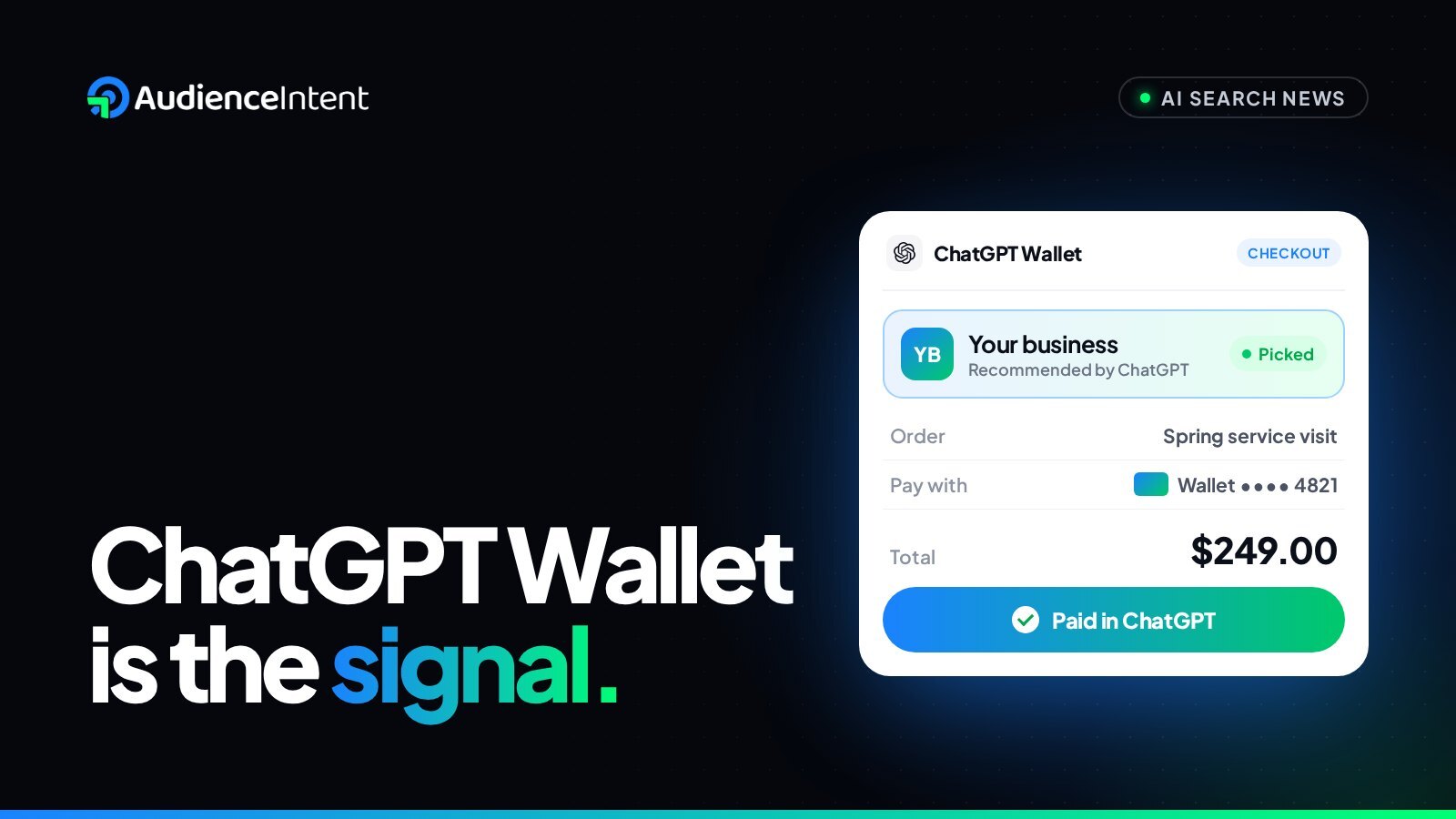
On November 13, 2026, OpenAI launched ChatGPT Wallet, a payment feature built directly into ChatGPT that lets AI agents complete purchases on your behalf. You ask. It finds. It buys. You never open a browser tab.
That's new. But the more important story isn't the payment feature itself. It's what Wallet, combined with the ChatGPT Business Hub launched just weeks earlier, confirms about where the customer journey is heading.
The search, the discovery, the decision, and the checkout are collapsing into a single conversation inside ChatGPT.
For businesses, this isn't a tech story. It's a distribution story. And the window to get positioned correctly is shorter than most people realize.
What ChatGPT Wallet Actually Does
ChatGPT Wallet stores payment credentials inside your ChatGPT account and authorizes AI agents to complete transactions on your behalf. According to OpenAI's announcement, it works across shopping, bookings, and service purchases, with users setting spending limits and approval thresholds.
The practical result: a user can ask ChatGPT to "find me the best HVAC company near me and book a diagnostic appointment" and, with Wallet enabled, ChatGPT can complete that booking without the user ever visiting a website.
Reuters reported that the feature is rolling out to ChatGPT Plus, Pro, and Team subscribers first, with broader availability to follow. TechCrunch noted that Wallet is deeply integrated with ChatGPT's agent capabilities, meaning the AI doesn't just find options, it evaluates them, selects one based on user preferences, and completes the transaction.
The scale that makes this matter
This isn't a feature being tested on a niche audience. CNBC reported that ChatGPT now serves more than 1.2 billion weekly active users. OpenAI is not building a payment feature for a small group of power users. They are building checkout infrastructure for what has quietly become one of the largest consumer platforms on earth.
To put that in context:
- Google Search processes roughly 8.5 billion queries per day
- ChatGPT's weekly active user count has grown from 100 million in early 2023 to 1.2 billion in late 2026
- That's 12x growth in under four years, faster than any consumer platform in recent history
The size of the audience means Wallet isn't an experiment. It's a bet on where consumer behavior is already going.
Wallet Plus Business Hub: The Full Picture
To understand why Wallet matters so much, you have to read it alongside the ChatGPT Business Hub, which OpenAI rolled out in the weeks prior. Business Hub gives businesses a structured presence inside ChatGPT, a place where business information, reviews, hours, and services can surface when users ask questions.
Put them together and the picture becomes clear:
| Stage | Old behavior | New behavior (ChatGPT) |
|---|---|---|
| Search | Google query | Ask ChatGPT a question |
| Discovery | Click through results | ChatGPT surfaces recommendations |
| Decision | Read reviews, compare sites | ChatGPT evaluates and suggests |
| Checkout | Visit website, enter card details | ChatGPT Wallet completes the purchase |
Every step of the customer journey, from the first question to the final payment, can now happen without the customer leaving ChatGPT.
This is not incremental. It's structural.
Traditional digital marketing was built on a model where Google sent people to websites. Businesses competed for clicks. Conversion happened on their own turf.
That model assumed the customer would visit your site. ChatGPT Wallet removes that assumption entirely.
If a customer asks ChatGPT to find and book a cleaning service, and ChatGPT recommends three options and books one of them using Wallet, your website never saw that customer. Your Google Analytics never logged that session. Your email capture never fired.
The business that got booked wasn't necessarily the one with the best website. It was the one ChatGPT knew enough about to recommend with confidence.
That's the shift. Visibility inside ChatGPT is no longer just a search channel play. It's now a direct line to revenue.
The AI Search Growth Trend That Makes This Inevitable
ChatGPT Wallet didn't appear in a vacuum. It's the logical endpoint of a behavioral shift that has been building for three years.
When ChatGPT launched in late 2022, people used it to write emails and explain concepts. By 2024, it had become a research tool. By 2026, with 1.2 billion weekly users, it's where a significant portion of consumer intent begins, including intent to buy.
AI is already changing how people find businesses
The data on this is consistent across industries. Consumers are increasingly starting their searches not with a keyword in a search bar, but with a question asked conversationally to an AI. "What's the best plumber near me?" "Which law firm handles employment cases in \[city\]?" "Can you find me a hotel with a pool and book two nights?"
These aren't hypothetical use cases. They're happening now, and the frequency is accelerating.
"Ninety days later, we're asking new customers where they found us and hearing 'ChatGPT'. That never happened before." — Nick Hines, Co-Founder, Vault Metal
Vault Metal went from 169 AI mentions to 7,808 in 90 days after optimizing for AI visibility. The channel is real. The customers coming through it are real. And with Wallet, those customers can now complete a purchase without any additional friction.
What AI agents change about the buying decision
Traditional search put the human in control of every step. They searched. They clicked. They compared. They chose. They checked out.
AI agents compress that process. The agent searches, compares, and can now check out. The human sets parameters ("find me something under $200, good reviews, available this week") and the agent executes.
This changes what it means to compete for a customer. It's no longer about having the most compelling website or the lowest price visible at the right moment. It's about being the business the AI has enough confidence in to recommend and act on.
That confidence comes from one thing: the quality and depth of information about your business that AI systems can access and verify.
What This Means for Your Business Right Now
Most businesses are not ready for this. That's not a criticism; it's a timing observation. The infrastructure for AI-driven commerce has moved faster than most marketing advice has caught up to.
Here's the practical gap: if ChatGPT doesn't know enough about your business to recommend it confidently, it won't. And if it won't recommend you, it certainly won't book a customer through Wallet on your behalf.
The three things AI needs to recommend a business
For an AI agent to include your business in a recommendation, and especially to act on that recommendation through a tool like Wallet, it needs:
- Accurate, accessible information about what you do, where you operate, and who you serve. This means structured data, clear service descriptions, and consistent information across the web.
- Social proof it can verify — reviews, citations, third-party mentions that confirm you are a real business with a real track record. AI systems cross-reference this.
- Answers to the questions customers actually ask. Not keyword-stuffed pages. Real answers to real questions, written in plain language that an AI can extract and trust.
Businesses that have these three things are the ones getting recommended today. With Wallet, they'll be the ones getting booked.
The businesses most exposed
Some categories face a more immediate impact than others. If your business relies on:
- Local service bookings (HVAC, plumbing, cleaning, landscaping, pest control)
- Professional appointments (law firms, accountants, consultants, therapists)
- Hospitality and travel (hotels, tours, experiences, restaurants)
- Ecommerce with specific product categories
...then you are exactly the type of business a ChatGPT user with Wallet enabled will ask about and potentially book through. The question is whether your business is in the answer.
Being absent from AI recommendations in 2026 is the equivalent of not having a website in 2005. The channel exists. Customers are using it. The businesses showing up are winning the ones who aren't, aren't.
The Counter-Argument Worth Addressing
Some business owners will read this and think: "Wallet is brand new. I'll wait and see how much adoption it gets before I do anything."
That's a reasonable instinct. But it misses the timing problem.
The businesses that get recommended by ChatGPT today aren't getting recommended because they optimized for Wallet. They're getting recommended because they built AI visibility over the past 12 to 18 months. When Wallet launched, they were already in position.
The businesses that wait until Wallet adoption is undeniable, until the data is impossible to ignore, will be trying to build that visibility from scratch while their competitors have already accumulated 18 months of citations, mentions, and AI trust signals.
This is the same pattern that played out with Google. The businesses that started SEO in 2004 dominated 2008. The businesses that started in 2008 were playing catch-up for years.
The right time to build AI visibility was 18 months ago. The second-best time is now.
Wallet isn't the reason to act. It's the confirmation that the direction was always right.
Getting Your Business Into the Conversation
The good news is that AI visibility is buildable. It's not a black box. The signals that make ChatGPT, Google AI, and Perplexity confident enough to recommend a business are knowable, and they can be built systematically.
At AudienceIntent, that's the only thing we do. We get businesses recommended by ChatGPT, Google AI, and Perplexity when people ask who to choose. Every client gets:
- A full audit of how AI currently sees their business
- Technical fixes so AI crawlers can access and understand their content
- A library of answers to the real questions their customers ask
- Fresh content published consistently, because AI engines weight recency
- Daily tracking across 50 prompts, so you can see your visibility grow week by week
Vault Metal went from 3 AI citations to 751 in 90 days. GoldenCrest Metals saw a 202.4% increase in visibility score in the same window. Craft Food Tours saw 312% more traffic from AI in 90 days.
These aren't edge cases. They're what happens when a business gives AI systems what they need to recommend it with confidence.
ChatGPT Wallet is the newest reason to take this seriously. But it's not the first, and it won't be the last.
If you want to know where your business stands right now, book a call with our team. We'll show you exactly what ChatGPT sees when someone asks about your category, and what it would take to be the business it recommends.
FAQs
Is ChatGPT Wallet the same thing as ChatGPT Business Hub?
No. Wallet is the payment layer. Business Hub is the discovery layer. Together, they point to the same outcome: people can ask, compare, choose, and buy without leaving ChatGPT. That is why the launch matters beyond payments.
Why does this matter for small and mid-sized businesses?
Because it changes where the customer journey starts and ends. If someone asks ChatGPT for a recommendation and completes the purchase there, the business that wins is the one ChatGPT trusts enough to surface. If you are not visible inside that system, you are out of the running.
Does ChatGPT Wallet replace Google?
Not overnight. But it does show where behavior is heading. More people are starting with a question instead of a search query, and Wallet removes one more reason to leave ChatGPT. Google is still huge, but the journey is no longer limited to Google.
What does ChatGPT need before it recommends a business?
It needs clear business information, verifiable proof, and strong answers to the questions customers actually ask. Structured data helps. Consistent details across the web help. Fresh, useful content helps. The more confident ChatGPT is, the more likely it is to recommend you.
What should a business do now?
Start by finding out how ChatGPT currently describes your company and your competitors. Then fix the gaps: technical access, service pages, answers to real questions, and recent content. The goal is not to chase a trend. It is to be the business ChatGPT already knows how to recommend.
Want this done for you?
We get your business recommended by AI. See the weekly report our clients get, or book a call.