Database Reactivation vs. Paid Ads: Which Produces Revenue Faster?
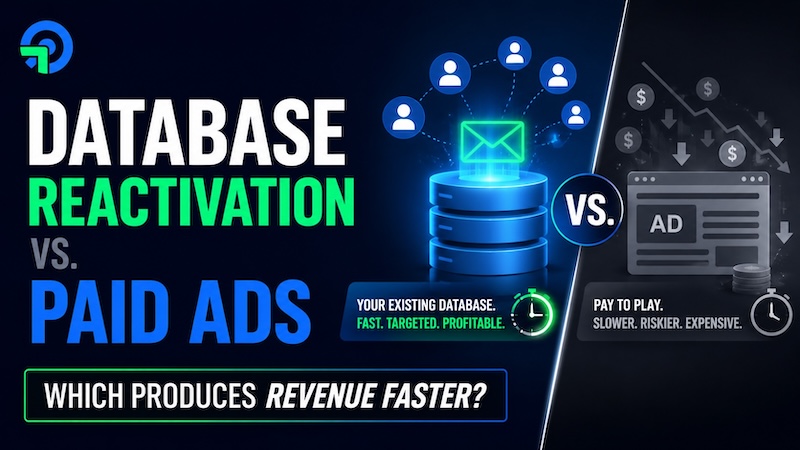
If you're running paid ads and wondering why revenue feels slow, the answer might not be your targeting, your creative, or your budget. It might be that you're solving the wrong problem first.
Most businesses sitting on a CRM full of past leads and unconverted inquiries are spending money to acquire strangers while ignoring people who already said yes once. That's not a targeting problem. It's a sequencing problem.
This article puts database reactivation and paid advertising head-to-head on the metrics that actually matter: speed to first revenue, cost per contact, conversion rate, and total ROI. The goal isn't to declare one channel dead. Paid ads serve a real purpose. But if you have a usable list and you need revenue in the next 30 days, the data points in one clear direction.
The core question: If you have 1,000 dormant contacts in your CRM and $5,000 to spend, which path generates revenue faster?
How Paid Ads Actually Work (And Why They Take Time)
Paid advertising on Google, Meta, or LinkedIn is a new-audience acquisition channel. You pay to reach strangers, earn their attention, and then hope enough of them convert to justify the spend. When it works, it scales. When it doesn't, you've paid for data.
The timeline is the part most business owners underestimate.
The Paid Ads Timeline
According to WordStream's 2025 Google Ads Benchmarks, the average cost per lead across all industries is now $70.11, up from $66.69 the year before. That's before accounting for the time it takes campaigns to perform.
Google's own learning phase runs 7 to 14 days minimum. Stable, optimized performance typically doesn't arrive until months 3 to 4. Peak ROI on most campaigns doesn't materialize until month 6 or later. Here's what that timeline looks like in practice:
| Milestone | Timeframe |
|---|---|
| Account approval | 24-48 hours |
| Learning phase completes | 7-14 days |
| First optimization cycle | 30-60 days |
| Campaign maturity / stable ROI | 90-120 days |
| Peak performance | 6-12 months |
Meta Ads move faster at the top of the funnel, but the consideration cycle for most service businesses and B2B purchases spans weeks to months. Meta's default attribution window is 7 days, which means campaigns that look inefficient on paper are often generating leads that close in week four or six.
What Paid Ads Actually Cost
The numbers are moving in the wrong direction. Google Ads CPL rose 5.13% from 2024 to 2025. Meta's average cost per lead hit $27.66 in 2025, up 20.94% year over year. LinkedIn's cost per click ranges from $5.58 to $15.72 depending on the quarter.
The practical reality: a business spending $5,000 on paid ads in month one should expect to generate roughly 70 to 180 leads at current Google benchmarks, with the bulk of those leads requiring follow-up, nurturing, and a sales process before any revenue closes. The first dollar of confirmed revenue from a new paid campaign often arrives 60 to 90 days in.
That's not a knock on paid ads. It's how the channel works. The problem is when businesses treat it as a fast-revenue lever when it isn't.
How Database Reactivation Works (And Why It's Faster)
Database reactivation is not a new lead channel. It's a recovery channel. The leads already exist. You already paid to acquire them. The only question is whether you've followed up well enough to convert them.
Most businesses haven't. According to InsideSales.com, 51% of leads are never contacted at all. The average business response time sits at 29 to 42 hours, a window in which most prospects have already moved on or chosen a competitor.
Database reactivation closes that gap using conversational SMS outreach. Instead of cold-blasting a list, the approach mirrors a real conversation: a personal, timed message that picks up where the original inquiry left off. The leads recognize the business. They've already expressed interest. That's not a cold call. That's a warm one.
The Reactivation Timeline
The speed difference is significant. A reactivation campaign can be live within 3 to 5 days of setup. Because the list already exists, there's no learning phase, no audience testing, and no waiting for the algorithm to find its footing.
| Milestone | Timeframe |
|---|---|
| Campaign setup | 1-3 days |
| Live and sending | Day 3-5 |
| First responses | Within 24-48 hours of launch |
| Measurable revenue | Week 1-2 |
Responses come in during the first 48 hours. Revenue follows within the first one to two weeks on a well-run campaign. That's not an estimate. That's how the channel works when the list is qualified and the messaging is right.
The Cost Advantage
The media cost on owned data is near zero. There's no click to buy, no impression to pay for. The only costs are message delivery (SMS runs at cents per contact) and campaign management.
Compare that to paid acquisition:
- Paid ads: $50 to $150 per new contact, with no prior relationship
- Reactivation: $300 to $1,500 per 1,000 contacts for a full campaign
That's a 5 to 8x cost advantage before accounting for the trust factor. A reactivated contact already knows the business. They don't need to be convinced it exists. They need a reason to come back.
The probability of selling to an existing contact is 60 to 70%, compared to 5 to 20% for a cold prospect. That gap in close rate, combined with the cost advantage, is what makes reactivation the faster path to confirmed revenue.
Head-to-Head: The Numbers Side by Side
Here's what the comparison looks like when you put both channels on the same scorecard, using real benchmark data.
| Metric | Paid Ads | Database Reactivation |
|---|---|---|
| Time to first revenue | 60-90 days | 7-14 days |
| Cost per contact | $50-$150 | $0.30-$1.50 |
| Conversion rate | 3-8% (cold traffic) | 10-25% (warm contacts) |
| Media spend required | Yes, ongoing | Near zero |
| Learning phase | 7-30+ days | None |
| Scales beyond list size | Yes | No |
| Revenue predictability | Low (month 1-2) | Higher (existing relationship) |
The numbers favor reactivation on every short-term metric. Paid ads win on one dimension that matters long-term: scale. A reactivation campaign is capped by the size of the existing list. Once that list is worked, you need new leads to refill the pipeline. That's where paid ads belong in the sequence, not as the starting point.
The $5,000 Scenario
Back to the original question. If a business has 1,000 dormant contacts and $5,000 to spend:
Option A: Paid Ads
- Budget: $5,000
- Estimated leads generated: 70-100 (at $50-$70 CPL)
- These are strangers. No prior relationship.
- First revenue likely in 60-90 days, after nurturing and follow-up
- Conversion rate: 3-8% of leads to customers
Option B: Database Reactivation
- Budget: $300-$1,500 to work the full 1,000-contact list
- These contacts already know the business
- First revenue likely in 7-14 days
- Conversion rate: 10-25% of engaged contacts
The math is not close. And the remaining $3,500 to $4,700 from the reactivation budget can fund the next channel, whether that's paid ads, AI search visibility, or both. For a full breakdown of how to calculate the ROI from your specific list and average job value, the variables are straightforward once you have your numbers.
What the Data Looks Like in Practice
The benchmarks above are industry averages. Real campaigns produce real numbers that either confirm or complicate the theory. Here's one that confirms it.
The ActivatedYou Test
ActivatedYou, a direct-to-consumer health and wellness brand, ran a controlled head-to-head test: their internal marketing team's reactivation campaign against an SMS reactivation campaign run externally, using same-size lists from the same dataset, in the same window, toward the same goal.
The results:
- 26.19% conversion rate on the SMS campaign
- $17.62 revenue per click
- Ranked first above the internal team on CTR, Average Order Value, and Revenue Per Message
"We put AudienceIntent up against our own internal marketing team's reactivation campaign. AudienceIntent won on CTR, Average Order Value, and Revenue Per Message. It wasn't close." — Hannah Ruiz, Head of Business Development, ActivatedYou
A 26% conversion rate on a dormant list is not a typical paid ads outcome. It's what happens when you reach people who already have context, interest, and a prior relationship with the brand.
Industry Benchmarks by Campaign Type
Not every reactivation campaign performs identically. The age of the lead and the nature of the original relationship both affect response rates. Here's what the data shows across campaign types:
| Campaign Type | Typical Response Rate |
|---|---|
| Lapsed customers (maintenance/repeat) | 12-20% |
| Old quotes (3-12 months) | 8-15% |
| Old quotes (12-24 months) | 5-10% |
| One-time customers (12+ months) | 6-12% |
Even at the low end, a 5% response rate on 1,000 contacts is 50 conversations with people who already know your business. At an average job value of $500, that's $25,000 in potential revenue from a list that was sitting idle.
When Paid Ads Are Still the Right Call
This comparison is not an argument for abandoning paid advertising. It's an argument for sequencing it correctly.
Paid ads make sense when:
- You have no usable list. If your CRM has fewer than a few hundred contacts, or the contacts are not TCPA-compliant opt-in leads, reactivation isn't viable. Paid acquisition is how you build the list in the first place.
- You've already worked your database. Once a reactivation campaign has run its course, you need new contacts entering the funnel. That's paid ads' job.
- You need volume at scale. A 5,000-contact list has a ceiling. A well-optimized Google Ads campaign doesn't. If your sales team can handle 500 leads a month, paid acquisition is the only channel that gets you there consistently.
- You're entering a new market. Reactivation works on existing relationships. If you're launching in a new geography or targeting a new customer segment, there's no prior relationship to reactivate.
The honest framing: paid ads and database reactivation are not competing strategies. They're sequential ones. Reactivation recovers revenue from what you already own. Paid ads build the next wave. Running both at the same time without first exhausting the reactivation opportunity is where most businesses waste money.
The pattern that works: run reactivation first, use the recovered revenue to fund paid acquisition, and let the new leads become tomorrow's reactivation list.
This is the same logic behind the self-funding model that lets businesses use reactivation revenue to fund longer-term visibility channels without adding to their marketing budget. The sequencing isn't just about speed. It's about not paying twice for the same audience.
What to Check Before You Decide
Before committing budget in either direction, three questions determine which channel to prioritize.
1\. How many contacts are in your CRM, and are they opt-in?
Database reactivation requires TCPA-compliant SMS opt-in leads. If your list was collected with proper consent, you have a reactivation asset. If it wasn't, or if the list is too small to be meaningful, paid ads are the starting point.
A useful threshold: 500 or more opt-in contacts is enough to run a meaningful campaign. 1,000 or more gives you a clearer read on results. For a deeper look at how your CRM stacks up against paid ads on ROI, the 2026 benchmarks are worth reviewing before you decide.
2\. How old are the leads, and what was the original context?
Leads from 3 to 18 months ago tend to perform best. The original inquiry is recent enough that the contact still has context, but enough time has passed that their situation may have changed and they're ready to move. Leads older than 24 months can still work, but response rates drop and messaging needs to account for the longer gap.
3\. What does revenue look like in the next 30 days vs. the next 6 months?
If the business needs revenue in the next 30 days, reactivation is the answer. If the business is in a stable position and building toward a larger pipeline over 6 to 12 months, paid ads become more relevant as part of the mix.
Most businesses that answer these questions honestly realize they need both, but they need reactivation first.
If you're not sure how much revenue is sitting in your existing database, the Lost Revenue Calculator runs the estimate in under a minute using your contact count, average job value, and industry. Most businesses are surprised by the number.
For businesses that want to explore what a reactivation campaign would look like for their specific list, a call takes 20 minutes and produces a clear picture of whether the list is worth working before any spend is committed.
Recover What's Yours. Own What's Next.
Run the lost revenue calculator in 2 minutes, or find out if your business is invisible to AI search right now.