Do You Know the 36 Other Places AI Checks Before Recommending You?
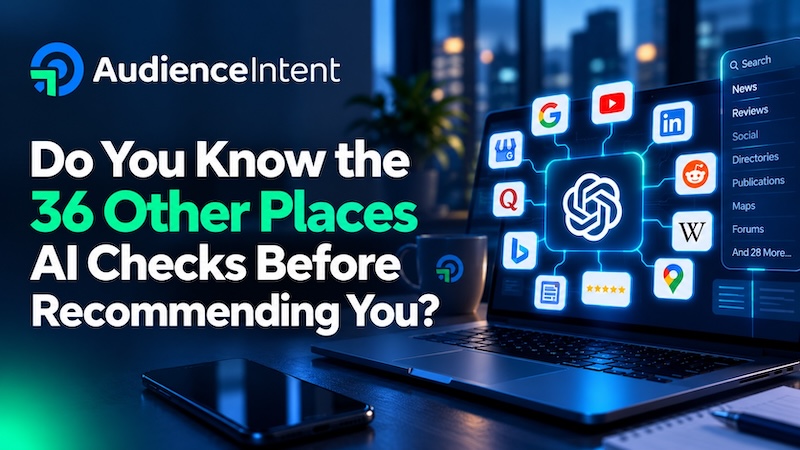
Most business owners assume AI recommendations work like Google search: build a good website, maybe keep a Google Business Profile current, and the algorithm takes care of the rest. That assumption is wrong, and it is costing businesses real customers every day.
When someone asks ChatGPT, Perplexity, Gemini, or Claude to recommend a service provider, those engines do not read your homepage and decide. They cross-reference a distributed web of third-party signals: directories, review platforms, community discussions, editorial coverage, structured data feeds, and more. Your website is one input among dozens. In many cases, it is not even the most important one.
The core problem: A September 2026 study analyzing 3,850 commercial prompts across ChatGPT, Google AI Mode, Perplexity, and Google AI Overviews found that sector directories supplied 41% of citations behind AI-generated provider recommendations, against just 18% for brand-owned pages. Your competitor with a mediocre website but strong third-party presence is getting recommended. You might not be.
This article maps where AI recommendation engines actually look, compares owned media against earned media as visibility drivers, and gives you a prioritized view of which source categories move the needle most. The goal is not to overwhelm you with a list of 37 things to fix. It is to reframe the problem so you can act on the right things first.
Owned Media vs. Earned Media: What AI Actually Weighs
Before mapping the source categories, it helps to understand the fundamental split in how AI engines treat content. Every signal they pull falls into one of two buckets.
Owned media is anything your brand controls directly: your website, your Google Business Profile, your social profiles, your blog posts. You write it, you publish it, you update it. The information is accurate (or should be), but the engine knows you wrote it about yourself.
Earned media is everything else: reviews customers left on Yelp, a mention in a local news article, a Reddit thread where someone recommended your business, a directory listing on Angi, an industry association membership page. You did not write it. A third party did, because of something you did or are.
Why Earned Media Carries More Weight
AI engines are in the business of making recommendations people trust. To do that, they need signals that cannot be easily manufactured. Owned media fails that test. Any business can write glowing copy about itself. Earned media is harder to fake at scale, which is why engines weight it more heavily when synthesizing a recommendation.
The data confirms this across multiple large studies:
- Across multiple 2026 citation studies, 82% to 85% of the sources AI engines cite in product and recommendation answers come from third parties, not the brand's own domain.
- A Yext Research analysis of 155.5 million AI citations in Q1 2026 found that between 69% and 85% of citations point to sources a brand can influence but does not own outright.
- In a study of 100 live "best \[category\] in \[city\]" searches through Gemini, directory and ranking sites appeared in 78% of answers. Individual business websites appeared too, but almost always as one-off citations in the long tail, never as a top-cited source.
The Platform Split Makes This Worse
Here is what makes the owned vs. earned distinction especially consequential: different AI engines weight these categories differently, and the overlap between what gets cited on one platform versus another is surprisingly small.
| Engine | Primary local data source | Third-party citation share |
|---|---|---|
| Gemini | Google Business Profile + Maps | ~48% of citations go to owned pages |
| ChatGPT | Bing, Foursquare, Yelp | 44.7% go to directories and review platforms |
| Perplexity | Live web + Reddit + Yelp | Community and UGC signals weighted heavily |
| Claude | Verified directories + authoritative sources | 19.5% from review platforms and social |
Source: Cheers market baseline, 356,019 citations, 28 days ending September 2, 2026; Yext Research Q1 2026.
A business optimized only for Gemini (strong Google Business Profile, well-structured website) is largely invisible to ChatGPT, which cannot see Google Reviews and pulls from Foursquare, Yelp, and Bing Places instead. Win one engine and you have done almost nothing for the others. The three major engines name the same local business just 6.5% of the time, according to the Yext 155.5 million citation panel.
The implication is direct: if your AI visibility strategy is "update the website and keep the GBP current," you are covering maybe 20% of the signal landscape and ignoring the 80% that decides whether a competitor gets named instead of you.
The Six Source Categories AI Checks (and How to Prioritize Them)
The 37 individual sources AI engines check are not equally important, and treating them as a flat list is the wrong way to approach this. Group them into six categories, understand what each category signals to the engine, and you can prioritize the work that actually changes your citation rate.
Category 1: Review Platforms (Highest Leverage)
Reviews are not just a reputation signal. They are a verification layer. AI engines use them to separate what a business claims about itself from what customers actually experienced.
Feefo's 2026 analysis found that ChatGPT references reviews in 58% of responses and Perplexity in 100% of responses. In Google AI Overviews, 34.5% of answers cite at least one review platform, and the top five review platforms hold 88% of all review citations.
The bar is also higher than most businesses realize. AI platforms have been observed recommending only businesses averaging 4.3 stars or higher on ChatGPT, 4.1 stars on Perplexity, and 3.9 stars on Gemini. Google Maps will still surface a business at 3.5 stars. AI will not.
Key review platforms by engine:
- ChatGPT: Yelp, TripAdvisor, Foursquare reviews (cannot access Google Reviews)
- Gemini: Google Reviews (primary), Trustpilot
- Perplexity: Yelp, Google Reviews, industry-specific platforms (Healthgrades, Avvo, Angi)
- Claude: BBB, high-trust industry directories, verified review platforms
The practical priority: volume and recency of reviews on Yelp and Google matter most across the broadest set of engines. If your Yelp profile has 12 reviews from 2021, that is a problem for ChatGPT visibility specifically.
Category 2: Directories and Listing Platforms (High Leverage)
This is the category most businesses underestimate. Directories are not just for SEO anymore. They are the primary citation source for AI on supplier-selection queries.
The September 2026 Citations.press study found that directories with consistent, structured data (one entity per entry, complete attributes) were cited 3.1 times more often than directories with free-text listings. Coverage depth within a stated category was a stronger predictor of citation than domain authority.
The most cited directory and listing platforms across AI engines in the U.S.:
| Platform | Primary engine benefit | Why it matters |
|---|---|---|
| Google Business Profile | Gemini, Google AI Overviews | Direct data feed to Google's AI layer |
| Yelp | ChatGPT, Perplexity | ChatGPT's primary local data source |
| Bing Places | ChatGPT | ChatGPT runs on the Bing index |
| Foursquare | ChatGPT | OpenAI licensed the Foursquare Places dataset |
| Apple Business Connect | Siri, Apple Intelligence | Separate AI ecosystem, often overlooked |
| BBB | Claude, Perplexity | High-trust verification signal |
| Angi / HomeAdvisor | ChatGPT, Perplexity | Heavily cited in home services queries |
| Industry-specific directories | All engines | Vertical relevance is a strong predictor |
Consistency across these platforms is not optional. ChatGPT's local data accuracy is only about 68%, meaning a third of what it says about your business can be wrong if your listings are stale or inconsistent. An incorrect phone number on Foursquare or an outdated address on Bing Places does not just inconvenience customers; it reduces your citation eligibility.
Category 3: Community Discussions and UGC (Medium-High Leverage)
Reddit is the most cited single domain across AI platforms, appearing in roughly 40% of LLM citations across all major engines, according to an aggregated index of 680 million citations harvested from ChatGPT, Google AI Overviews, Perplexity, Gemini, and Claude between August 2024 and April 2026.
For Perplexity specifically, Reddit accounts for 46.7% of top sources. This is not a quirk. Perplexity is the only major engine that actively trusts user-generated content, including Facebook community groups and Nextdoor alongside Reddit.
What this means in practice: if customers in your city are discussing your category on Reddit and your business is not mentioned, or worse, a competitor is mentioned positively, that shapes Perplexity's recommendations. You cannot post fake Reddit threads (the platform's detection is good and AI engines are increasingly sensitive to manufactured UGC), but you can earn genuine mentions by being genuinely good and by being findable in the communities where your customers already talk.
Other community sources that factor in: Quora threads, Nextdoor business recommendations, Facebook Groups, and niche forums specific to your industry.
Category 4: Editorial and Publisher Coverage (Medium Leverage)
When an AI engine wants to corroborate a recommendation, it looks for third-party editorial coverage: news articles, "best of" lists, industry publications, and ranked guides. Forbes, for example, appeared in 11 of 100 answers in the Gemini recommendation study. Healthgrades appeared in 9.
This category is harder to earn quickly, but it compounds. A mention in a credible local news outlet, a spot on a "best \[category\] in \[city\]" list from a regional publication, or coverage in an industry trade journal all serve as corroborating signals that the engine can cite alongside directory data.
The key distinction: these are not links for SEO. They are entity mentions that confirm your business exists, operates in a specific category, and has been recognized by a credible third party. The engine does not need to rank the article. It needs to find the mention.
Category 5: Structured Data and Knowledge Graph Signals (Medium Leverage)
AI engines build entity models of businesses: a structured understanding of who you are, what you do, where you operate, and how you relate to other entities. Structured data on your website (LocalBusiness schema, FAQ schema, service-area markup) feeds this model directly.
Wikipedia and Wikidata play a role here for larger or more established businesses. ChatGPT cites Wikipedia in 2.49% of all its responses and it is the single most-cited domain in ChatGPT's top-ten sources. For most local businesses, Wikipedia is not accessible, but Wikidata entity records and structured schema on your own site serve a similar function at a smaller scale.
Structured data priorities:
- LocalBusiness schema with accurate NAP (name, address, phone), categories, hours, and service area
- FAQ schema on service pages (maps to how customers phrase AI queries)
- Review schema to surface aggregate ratings
- Breadcrumb and sitelinks schema for entity clarity
Category 6: Social Profiles and Brand Mentions (Lower Leverage, Still Real)
Social profiles are the weakest signal category for AI recommendations, but they are not irrelevant. Claude draws 19.5% of its citations from review platforms and social profiles, roughly 7.5 times OpenAI's rate of about 2.6%. If Claude is part of your target audience's AI behavior, social presence matters more than it does for ChatGPT optimization.
The more important signal in this category is brand mention consistency: your business name appearing in the same form across LinkedIn, Facebook, Instagram, and YouTube, matching what appears in your directory listings. Inconsistency across these profiles creates entity confusion for the engine, which reduces confidence in recommending you.
Where Most Businesses Are Actually Spending Their Time
The gap between where businesses invest their visibility effort and where AI engines actually look is the central problem. Most businesses concentrate almost entirely on owned media: website updates, social posts, maybe a Google Business Profile refresh. That work is not wasted, but it addresses a fraction of the signal landscape.
Here is a rough breakdown of where AI citation weight actually falls across the source categories, based on the 2026 studies cited above:
The takeaway here is not that your website does not matter. It does, especially for Gemini, which sends nearly 60% of its local citations to business websites. The takeaway is that your website alone cannot carry your AI visibility, and for ChatGPT, which handles roughly 78% of local AI query volume, third-party sources are doing more of the work than your own pages.
The effort-to-impact mismatch looks like this:
Most businesses spend roughly 80% of their digital marketing effort on owned media (website, social, content) and 20% or less on earned media (reviews, directories, press). AI recommendation engines weight those categories in roughly the opposite proportion. That inversion is why businesses with strong traditional SEO can still be invisible in AI search.
The fix is not to abandon your website. It is to build the earned media layer that AI engines are actually checking.
A Prioritization Map: Where to Start
Not every business needs to be on every platform. The right starting point depends on your category, your primary AI engine exposure, and how much of the baseline is already in place. That said, the research points to a clear sequence for most businesses.
Tier 1: Fix Before Anything Else
These are the signals that, if wrong or missing, actively disqualify you from AI recommendations regardless of what else you do.
- Review rating below 4.0 on major platforms. This is close to a hard floor for AI recommendation eligibility, not a ranking nudge. Address it before building out listings.
- Inconsistent NAP data across platforms. Name, address, and phone number must match exactly across Google, Yelp, Bing, Foursquare, and any directory you appear in. Inconsistency creates entity confusion.
- Unclaimed or stale listings on Yelp, Bing Places, and Foursquare. These three feed ChatGPT directly. A stale listing is worse than no listing because it can contain wrong information that gets cited.
Tier 2: Build the Core Earned Media Stack
Once the baseline is clean, build presence in the platforms with the highest citation frequency across the broadest set of engines.
- Google Business Profile (complete, with photos, services, posts, and active review responses)
- Yelp (claimed, complete, actively soliciting reviews)
- Bing Places (claimed and synced with your GBP data)
- Foursquare (claimed, complete, consistent with other listings)
- Apple Business Connect (overlooked by most businesses, feeds Siri and Apple Maps AI)
- BBB accreditation (high-trust signal for Claude and Perplexity)
- Your top 2-3 vertical directories (Angi for home services, Healthgrades for healthcare, Avvo for legal, etc.)
Tier 3: Earn the Harder Signals
These take longer but compound over time and are harder for competitors to replicate quickly.
- Community presence: Genuine mentions in Reddit threads, Nextdoor recommendations, and local Facebook Groups. These cannot be manufactured, but they can be earned by being active and excellent in your market.
- Editorial coverage: A spot on a credible "best of" list, a local news mention, or a trade publication feature. Pitch these proactively; they do not happen by accident.
- Content that answers real questions: Pages on your site that directly answer the questions your customers ask AI assistants, structured with FAQ schema, are cited at higher rates than generic service pages.
The compounding effect matters. Rankability's 2026 citation study found that pages cited across eight or more queries had a 43.3% top-10 AI citation rate, compared to 15.5% for pages cited only once. Presence across multiple source categories creates a citation flywheel: the more places you appear, the more likely AI engines are to cite you, which increases the probability of appearing in future answers.
What Not to Do
A few common mistakes that waste time or actively hurt AI visibility:
- Optimizing only for Google. Google's AI ecosystem (Gemini, AI Overviews) and ChatGPT pull from almost entirely different source sets. Ranking well in Google Search does not transfer to ChatGPT recommendations.
- Chasing domain authority for directories. The September 2026 study found a weak correlation (Spearman rank of 0.19) between a directory's domain authority and how often it was cited. Coverage depth within a stated category was the stronger predictor. Being listed thoroughly in a niche directory beats a thin listing on a high-DA general one.
- Treating AI visibility as a one-time project. Roughly 75% to 88% of the sources AI cites change day to day. Platforms update, engines reweight sources, and new directories gain traction. This requires ongoing monitoring, not a single audit.
The Real Question Is What You Do Next
AI recommendation engines are not reading your website and making a judgment call. They are running a verification process across dozens of third-party sources, and the businesses that show up consistently across that ecosystem are the ones getting recommended.
Your website is not the problem. The gap in your earned media footprint is.
The first step is knowing where you actually stand. Most businesses have no idea how they appear across the source categories that matter, which listings are stale, which review platforms are dragging down their citation eligibility, or which AI engines are currently recommending a competitor instead of them.
Run the free AI Visibility Audit at report.audienceintent.ai. It shows you where you stand across the sources AI engines check, what is incomplete or inconsistent, and where the highest-leverage gaps are. Takes a few minutes. The results are specific to your business and your category, not a generic checklist.
The businesses that move on this now are building a citation footprint that compounds. The ones that wait are watching competitors get recommended in their place.
All 36 Sources: A Complete Reference by Category
Use this as a working checklist. The six categories match the prioritization framework above. Start with Tier 1 fixes before working down the list.
Category 1: Review Platforms
- Google Reviews
- Yelp
- TripAdvisor
- Trustpilot
- BBB (Better Business Bureau)
- Healthgrades (healthcare)
- Avvo (legal)
- Houzz (home improvement)
Category 2: Directories and Listing Platforms
- Google Business Profile
- Bing Places for Business
- Foursquare
- Apple Business Connect
- Angi (formerly Angie's List)
- HomeAdvisor
- Thumbtack
- Clutch (B2B services)
- Hoover's / Dun & Bradstreet (B2B)
- Chamber of Commerce directories
- Industry association member directories
Category 3: Community Discussions and UGC
- Reddit (subreddits relevant to your category and city)
- Quora (question threads in your topic area)
- Nextdoor (local business recommendations)
- Facebook Groups (local and niche community groups)
- Alignable (small business community)
Category 4: Editorial and Publisher Coverage
- Local news outlets and city publications
- Regional "best of" lists and award publications
- Industry trade journals and vertical publications
- Forbes, Inc., Entrepreneur (for broader category mentions)
- Podcast mentions and episode show notes
- Guest articles and bylined contributor pieces
Category 5: Structured Data and Knowledge Graph Signals
- Your website's LocalBusiness schema markup
- FAQ schema on service and landing pages
- Wikidata entity record (for established businesses)
- Wikipedia (for businesses with sufficient notability)
- Schema.org review and aggregate rating markup
Category 6: Social Profiles and Brand Mentions
- LinkedIn company page (especially for B2B and professional services)
Note on scope: Several of these sources overlap in function depending on your industry. A legal practice weights Avvo and Justia more heavily than Angi. A home services business reverses that. The six-category framework matters more than hitting every individual source. Prioritize the platforms where your customers already look and where the AI engines serving your market pull most of their data.
Recover What's Yours. Own What's Next.
Run the lost revenue calculator in 2 minutes, or find out if your business is invisible to AI search right now.