If a Miami Homeowner Asks AI Who to Call for Their Roof, Will Your Name Come Up?
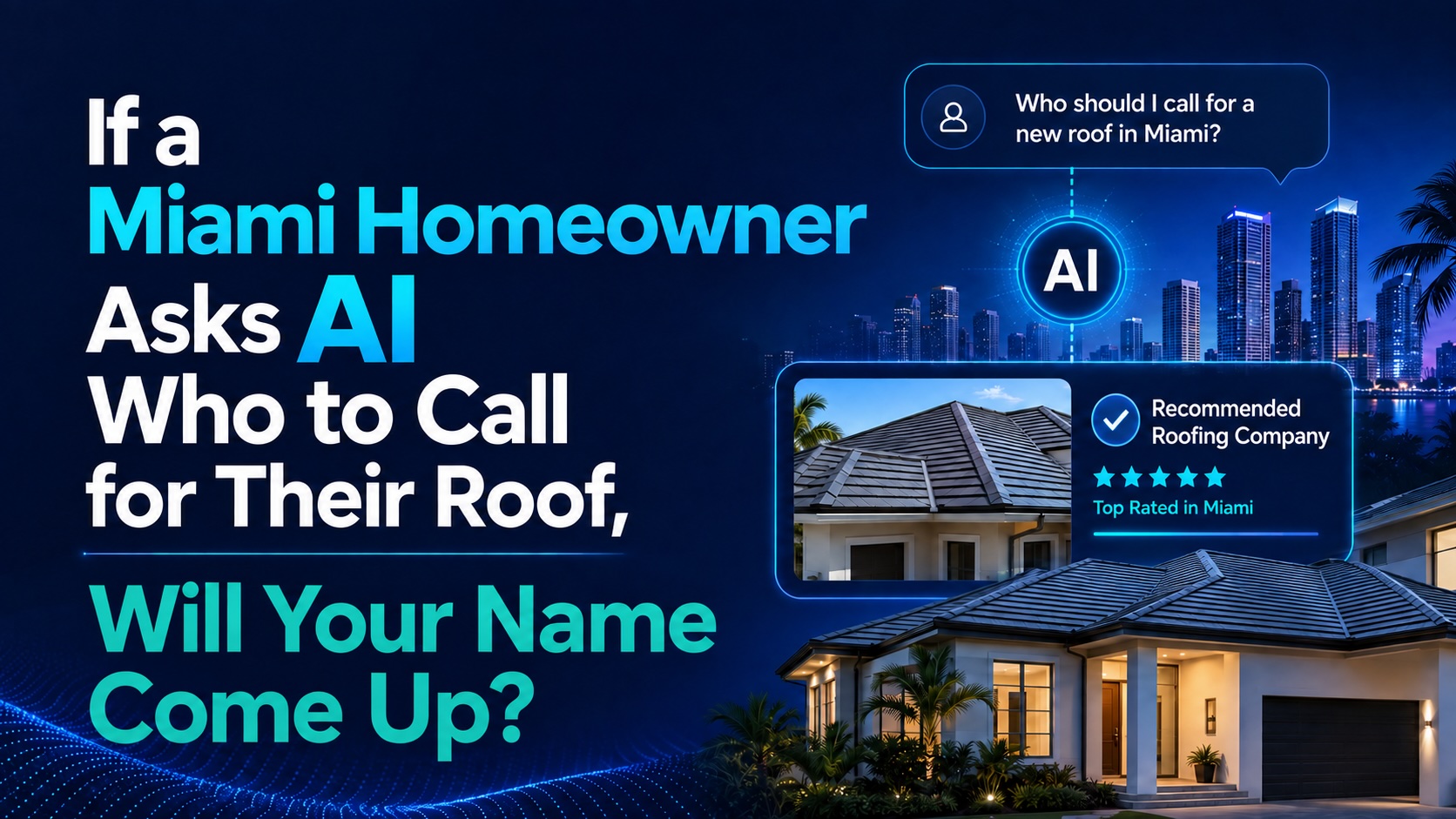
It's a Tuesday morning in Coral Gables. A homeowner walks outside after last night's storm and spots a dark water stain spreading across her living room ceiling. She doesn't open Google. She picks up her phone, opens ChatGPT, and types: "Who is the best roofing company in Miami for storm damage repair?"
Thirty seconds later, she has three names. She calls the first one.
If your roofing company isn't one of those three names, you didn't lose a lead because your price was too high or your reviews weren't good enough. You lost it because you were invisible at the exact moment the customer decided who to call.
This is the new reality of local business discovery. AI assistants, including ChatGPT, Google's AI Mode, Perplexity, and Gemini, are now actively recommending local contractors by name. According to BrightLocal's 2026 Local Consumer Review Survey, 45% of US consumers used AI tools for local business recommendations in the past year, up from just 6% the year before. That's not a trend on the horizon. It's already happening in your market, to your potential customers, right now.
This article is for the roofing company owner who has invested in a website, paid for Google Ads, and built up a solid review count, but hasn't yet asked the most important question of 2026: does AI know I exist?
Here's what you need to understand, why it matters more in Miami than almost anywhere else in the country, and what to do about it before your competitors figure it out first.
AI Isn't Just Searching. It's Recommending.
There's a fundamental difference between how Google works and how AI assistants work, and most business owners haven't fully absorbed what that difference means for their revenue.
When someone types "roofers in Miami" into Google, they get a page of ten or more results. The homeowner scrolls, compares, clicks around, reads reviews, and eventually makes a choice. Your job in that world is to show up somewhere in the list and be compelling enough to get the click.
AI doesn't work that way.
When someone asks ChatGPT or Perplexity who to call for a roof repair in Miami, they get a finished answer. Not a list of ten options. A recommendation of three to five businesses, presented as a direct response to their question. The AI has already done the "evaluation" step for them.
The implications of this are significant:
- There is no position #8 in an AI answer. You're either in the shortlist or you don't exist.
- SOCi's 2026 Local Visibility Index found ChatGPT recommended just 1.2% of local brand locations across all categories, compared to 11% for Gemini and 7.4% for Perplexity.
- 40% of consumers trust AI business recommendations, and 42% trust them as much as they trust traditional reviews (BrightLocal, 2026).
That last number is worth sitting with. Nearly half of people who get a recommendation from ChatGPT trust it the same way they'd trust a five-star review from a verified customer. They're not skeptical. They're not double-checking. They're calling.
The Three Questions Miami Homeowners Are Asking AI Right Now
Research into roofing-related AI queries reveals three distinct query types, each with different triggers and different implications for which businesses get named.
| Query Type | Example Prompt | What AI Rewards |
|---|---|---|
| Cost questions | "How much does a roof replacement cost in Miami?" | Businesses that publish real, local pricing information |
| Urgency questions | "Roof leaking after the storm, who do I call in Miami?" | Businesses with stated response times and emergency service pages |
| Diligence questions | "Best licensed roofer in Miami-Dade, who is legit?" | Businesses with visible license numbers, reviews, and third-party citations |
According to a Florida Roofing AI Visibility Study by Local Vitals, AI named specific roofing businesses 73.6% of the time when queried about Florida contractors. But 97.2% of the roofers named appeared on only one AI platform. That means a business showing up in ChatGPT is almost certainly invisible in Gemini, and vice versa.
The window to be one of the few businesses that shows up across multiple platforms is open right now. It won't stay open.
Why Miami Roofing Is the Highest-Stakes Local AI Visibility Market in the Country
AI visibility matters for any local business. But for a roofing company operating in Miami-Dade County, the stakes are higher than almost anywhere else in the United States. Here's why.
Six Months of Hurricane Season Creates Six Months of High-Intent Queries
Hurricane season runs from June 1 through November 30 every year. That's half the calendar where Miami homeowners are actively thinking about their roofs, checking their insurance policies, and, after any significant storm event, frantically searching for contractors.
Storm events spike roofing search volume by 400 to 900 percent in affected zip codes for two to six weeks, according to local SEO research on roofing markets. But here's the problem with relying on Google alone: Google needs months to index and assign authority to new pages. A company that publishes storm-damage content the week a storm hits will never rank in time.
AI is different. When a homeowner opens ChatGPT at 11pm after a storm and asks who handles emergency tarping in Brickell, the AI pulls from its existing knowledge of which businesses have established a credible presence. The businesses that built that presence before the storm get named. The ones who didn't, don't.
This is the single most important timing insight for Miami roofing companies: the work of getting AI-visible has to happen before the storm, not after it.
The High-Dollar Homeowner Is Already Using AI
The customers who matter most to a roofing company's revenue are already using AI to find contractors. Houzz's 2026 US Houzz & Home Report found that 28% of homeowners who started a $50,000-or-larger remodel in 2025 used an AI assistant during contractor research. For projects under $25,000, that number was 12%.
The size-of-project gradient is sharp: the bigger the budget, the more likely the homeowner used AI to vet contractors before making a call.
For a Miami roofer, a full tile roof replacement on a Coral Gables home can run $25,000 to $50,000 or more. Those are exactly the customers using AI to decide who gets the call. They're also the customers least likely to pick the first result they see on Yelp without doing additional research.
Miami-Dade's Regulatory Complexity Creates a Trust Signal Opportunity
Miami-Dade County operates under some of the strictest building codes in the country, including the Miami-Dade Product Approval system that governs which roofing materials can legally be installed. This creates a real credibility gap between licensed, code-compliant contractors and unlicensed operators.
AI assistants pull from license records, permit data, and third-party review platforms when evaluating which businesses to recommend. A Miami roofing company with a clearly published state license number, Miami-Dade Product Approval documentation, and a strong presence on Yelp, Google, and Angi is positioned to be cited. One without those signals is invisible regardless of how good their actual work is.
The practical takeaway: Miami's regulatory environment is a feature, not a burden. Contractors who make their credentials visible and machine-readable are more likely to be recommended by AI than those who don't, even if both companies do equally good work.
Your Google Rankings Don't Transfer to AI
This is the part most business owners get wrong. They assume that because they rank well on Google, they're probably showing up in AI answers too. The data says otherwise.
Ahrefs analyzed 15,000 long-tail queries and found that only about 12% of AI-cited URLs rank in Google's top 10 for the same query. For ChatGPT specifically, that number drops to around 8%. For Perplexity, it's higher at 28.6%, but still means roughly seven out of ten citations come from pages that don't rank highly in traditional search.
The two systems are almost entirely separate ecosystems. A business can have a page-one Google ranking and be completely absent from AI recommendations. Conversely, a business with no meaningful Google presence can be cited regularly by ChatGPT if it has strong third-party platform footprints.
Where AI Actually Gets Its Information
When an AI assistant recommends a local contractor, it's pulling from a specific set of sources. Yext's analysis of 6.8 million citations found that nearly half of ChatGPT's citations point to third-party sites rather than business websites directly. Local Dominator's analysis of 267,280 AI citations from local business campaigns identified the most commonly cited platforms:
| Platform | Citations in Study |
|---|---|
| Yelp | 71,512 |
| 55,977 | |
| 36,678 | |
| 24,012 | |
| Angi | 17,360 |
| BBB | Lower volume |
| HomeAdvisor | Lower volume |
The implication for a Miami roofing company is direct: your website alone is not enough. If your Yelp profile is thin, your Angi listing is unclaimed, and you have no presence on Reddit or community forums, you're missing the exact sources AI engines pull from most heavily.
The SEO Investment You Already Made Won't Protect You
Many roofing companies in Miami have invested real money in SEO over the past several years. That investment has value, but it doesn't carry over to AI visibility automatically.
According to AudienceIntent's research on AI citation patterns, 85% of brand mentions in AI answers come from third-party sources, not from the business's own website. The businesses that rank in AI answers have typically built a presence across multiple external platforms, published content that directly answers the questions AI users are asking, and made their credentials easy for AI systems to read and verify.
A strong Google ranking tells Google's algorithm you're authoritative. It does not tell ChatGPT the same thing. Those are different systems, trained on different data, with different citation logic.
What AI Visibility Actually Looks Like for a Miami Roofing Company
Let's make this concrete. Here's what the difference looks like between a Miami roofing company that has built AI visibility and one that hasn't, using the same hypothetical business.
Scenario A: The Invisible Roofer
Marco runs a roofing company in Hialeah. He's been in business for 11 years. He has 87 Google reviews averaging 4.7 stars. He ranks on page one of Google for "roof repair Hialeah." His website was redesigned two years ago and looks professional.
After a tropical storm rolls through in September, a homeowner in Hialeah Gardens opens ChatGPT and asks: "Who are the most trusted roofers in Hialeah for storm damage?"
Marco's company doesn't come up. Not because his work is bad. Not because his reviews are weak. But because:
- His Yelp profile is unclaimed and has three reviews from 2019.
- His Angi listing was set up once and never updated.
- His website doesn't mention specific neighborhoods, response times, or storm damage services in plain text.
- His state license number isn't visible on his website in crawlable text.
- He has no content published that answers the kinds of questions AI users ask.
The homeowner calls one of the three businesses ChatGPT named. Marco never knew the lead existed.
Scenario B: The AI-Visible Roofer
Elena runs a competing roofing company in the same market. She has similar experience, similar reviews, and a similar service area. But over the past six months, she made her business visible to AI systems.
- Her Yelp profile is fully built out, with 60+ recent reviews and detailed service descriptions.
- Her Angi and HomeAdvisor listings are claimed, complete, and updated with current service offerings.
- Her website has a dedicated storm damage page that states her typical response time (24 hours for inspection, same-day tarping for active leaks) and lists the neighborhoods she serves by name.
- Her Florida state contractor license number appears in plain text in her website footer.
- She has published three blog posts in the past 90 days that directly answer questions like "how much does a tile roof replacement cost in Miami-Dade?" with real numbers.
After the same storm, the same homeowner asks ChatGPT the same question. Elena's company is one of three names in the answer.
The difference between Marco and Elena isn't talent, price, or reputation. It's legibility. AI systems can read and verify Elena's business. They can't read Marco's.
The Revenue Math
Traffic from AI search converts at 4.4 times the rate of standard organic search, 14.2% versus 2.8%, based on tracked campaign data. For a roofing company where a single job can be worth $8,000 to $40,000, the difference between being in the AI shortlist and being invisible isn't a marketing metric. It's a revenue line item.
In Q1 2026 alone, AI chatbots sent over 2,300 leads to contractors on one tracking platform, with ChatGPT-sourced leads surging 47% in March alone, according to RoofDA's 2026 AI search analysis. That number is growing every month, and the roofing companies capturing those leads are the ones who built their AI presence before the volume arrived.
The First-Mover Window Is Real, and It's Closing
Less than 1% of roofing companies have taken any steps to optimize for AI recommendations. That number comes from multiple sources tracking AEO adoption across local service businesses, and it represents one of the clearest first-mover opportunities in local marketing right now.
Here's the honest framing: AI visibility is not technically complicated. The businesses that show up in AI answers aren't doing anything exotic. They're doing the basics well, consistently, across the right platforms. The reason most roofing companies aren't doing it isn't that it's hard. It's that most roofing companies don't know it needs to be done.
That gap won't last.
What Changes When Competitors Move First
When one roofing company in a Miami market builds strong AI visibility and others don't, the math gets brutal fast. AI typically recommends three to five businesses per query. In a metro area with dozens of roofing companies, only a handful will be in those shortlists on any given query.
The businesses that get named first tend to accumulate more reviews, more citations, and more third-party mentions, which reinforces their AI visibility further. It's a compounding effect. The early mover doesn't just win the first customer who asks AI for a recommendation. They build the kind of multi-platform presence that keeps generating citations over time.
Waiting is not a neutral decision. Every month a Miami roofing company delays building AI visibility is a month their competitors have to establish the citation footprint that's hard to displace later.
The Timing Problem Is Specific to Miami
Most markets have some buffer time. Miami doesn't. Hurricane season creates an annual window where roofing demand spikes sharply, and the businesses that AI recommends during that window capture an outsized share of the year's revenue. Building AI visibility takes time, typically 30 to 90 days before measurable citation growth appears.
A Miami roofing company that starts this work in October is positioned for the following hurricane season. One that starts in June, after the season is already underway, is building for the year after that.
The time to start is before you need it. That's always been true in marketing. It's especially true here.
How to Check If Your Business Is Invisible to AI Right Now
Before investing in any solution, do this test. It takes five minutes and gives you a real answer.
The Five-Query Test
Open ChatGPT, Perplexity, and Google's AI Mode in separate private/incognito windows. Run these five queries, substituting your actual city and specialty:
- "Best roofing company in \[your city\] for storm damage repair"
- "Who should I call for an emergency roof leak in \[your city\]?"
- "How much does a roof replacement cost in \[your city\]?"
- "Most trusted licensed roofer in \[your county\]"
- "Roofing contractor in \[your city\] for tile roof replacement"
Record your results in a simple table:
| Query | ChatGPT | Perplexity | Google AI |
|---|---|---|---|
| Storm damage repair | Named? | Named? | Named? |
| Emergency roof leak | Named? | Named? | Named? |
| Roof replacement cost | Named? | Named? | Named? |
| Trusted licensed roofer | Named? | Named? | Named? |
| Tile roof replacement | Named? | Named? | Named? |
How to interpret your results:
- 0 out of 15 cells: Your business has no AI visibility. This is the most common result. It's fixable.
- 1 to 4 out of 15: You have partial visibility on one platform. You're ahead of most competitors but leaving significant coverage on the table.
- 5 to 10 out of 15: You have meaningful AI visibility. The next step is expanding coverage across all three platforms and tracking it consistently.
- 11 or more out of 15: You're in the top tier of AI-visible local businesses. The work now is maintenance and defending your position as competitors catch up.
Most Miami roofing companies will score zero. That's not an insult. It's the current state of the market, and it's the reason the first-mover opportunity is real.
What to Do With the Results
If you scored zero or close to it, the audit tells you where to start. A free AI visibility audit can give you a more detailed picture of where your business stands across all major AI platforms, which sources are currently being cited in your category, and what specific gaps are keeping you out of the shortlist.
The audit doesn't require any technical setup. It's a starting point for understanding what AI platforms currently know about your business, and what they don't.
This Applies Beyond Roofing
The roofing example is specific because Miami's storm market makes the stakes unusually clear. But the underlying dynamic applies to any local service business where customers make high-consideration hiring decisions.
HVAC companies in Phoenix. Plumbers in Houston. Electricians in Atlanta. Landscapers in Denver. Any business where a customer is choosing a contractor for work that costs thousands of dollars and requires trust is a business where AI recommendations are already influencing the shortlist.
The common thread across all of these categories:
- The jobs are high-value. Customers are motivated to do research before calling.
- The decisions are trust-driven. Customers want validation before handing over access to their home.
- The queries are conversational. "Who should I hire for..." is exactly the kind of question people ask AI assistants.
- The market is local. AI platforms are actively trying to return local business names in response to these queries, and they're succeeding 73% of the time in the roofing category alone.
If you run a local service business and your customers make decisions that feel like hiring decisions rather than purchase decisions, your next customer is probably already asking AI who to call. The question is whether your name is in the answer.
Frequently Asked Questions
Does AI visibility replace SEO?
No. They're separate systems that serve different discovery channels. SEO gets your website ranked in Google's blue-link results. AI visibility gets your business cited when someone asks an AI assistant for a recommendation. Only about 12% of pages cited by ChatGPT rank in Google's top 10 for the same query, meaning the two ecosystems have very little overlap. A Miami roofing company needs both, because different customers use different tools. Treating AI visibility as an either/or with SEO is a mistake.
How long does it take to start showing up in AI recommendations?
It varies by market, competition, and how much foundational work needs to be done. In categories with low AI visibility adoption (which includes most local roofing markets right now), businesses that build out their third-party platform presence and publish relevant content can see measurable citation growth within 30 to 60 days. Broader, consistent visibility across multiple AI platforms typically develops over 60 to 90 days. There is no shortcut, but there is a clear sequence of steps that produces results.
My Google reviews are strong. Doesn't that help with AI?
It helps, but it's not sufficient on its own. AI assistants pull from multiple sources, and Google reviews are just one of them. Yelp, Angi, Facebook, Reddit, and other third-party platforms are heavily cited in AI answers. A business with 200 Google reviews and a thin Yelp profile is still partially invisible to AI. The goal is a consistent, complete presence across all the platforms AI engines trust.
What kinds of content does AI use to recommend local businesses?
AI systems favor content that directly answers the questions users are asking. For roofing companies, that means pages that state specific pricing ranges for common jobs in your market, pages that describe your response time for emergency situations, service area pages that list specific neighborhoods and zip codes by name, and content that explains your credentials, license numbers, and any specialty certifications. Content buried in images or behind JavaScript that AI crawlers can't read does not count.
Is AI visibility only relevant during hurricane season in Miami?
No. Hurricane season amplifies the urgency because search volume spikes sharply, but Miami homeowners are asking AI for roofing recommendations year-round. Roof inspections before selling a home, tile roof replacements on aging properties, and flat roof maintenance for commercial buildings are all year-round categories. Building AI visibility now means capturing those leads throughout the year, not just during storm season.
What's the difference between AI visibility and being listed in AI directories?
AI visibility isn't about being listed in a specific directory. It's about building a presence across the sources that AI assistants actually pull from when generating recommendations, including Yelp, Angi, Google Business Profile, Reddit, Facebook, and your own website. There is no single "AI directory" to submit to. The work is building a consistent, credible, and machine-readable presence across multiple platforms that AI engines already trust.
How do I know if a customer found me through AI?
Ask. The most reliable method is adding "how did you hear about us?" to your intake process and including AI assistants as an explicit option alongside Google, referral, and social media. Some tracking platforms are beginning to attribute AI-sourced leads through referral URL patterns, but direct inquiry remains the most practical method for most small businesses. As AI traffic grows, the pattern will become visible in your data.
Can any agency guarantee my business will appear in ChatGPT's answers?
No legitimate agency can guarantee placement in a specific AI answer. AI platforms generate recommendations dynamically, and no third party controls what any AI engine decides to say. What a reputable agency can do is build the citation footprint, content, and platform presence that makes your business significantly more likely to be cited, and track your visibility over time across the major AI platforms. Be skeptical of any vendor claiming guaranteed placement.
The Bottom Line
A Miami homeowner with a damaged roof is not going to wait. They're going to ask AI who to call, get three names, and dial the first one. That transaction is happening right now, today, in your market.
The only question is whether your business is in the answer.
Most roofing companies in Miami aren't. Not because they're bad at their jobs, but because they haven't built the presence that AI systems need to recommend them. That's a solvable problem, and the window to solve it before competitors do is still open.
Start with the five-query test above. Open ChatGPT and Perplexity right now and ask who the best roofers in your city are. See your own name, or don't. Either way, you'll know exactly where you stand.
If you want a complete picture across all major AI platforms, including which sources are currently being cited in your category and what specific gaps are keeping you out of the shortlist, run a free AI visibility audit at report.audienceintent.ai. It takes a few minutes and gives you a clear starting point.
The next customer is already asking. The question is whether you're in the answer.
Recover What's Yours. Own What's Next.
Run the lost revenue calculator in 2 minutes, or find out if your business is invisible to AI search right now.