
Is AEO Important? The Numbers Behind the AI Search Explosion You Can't Afford to Ignore

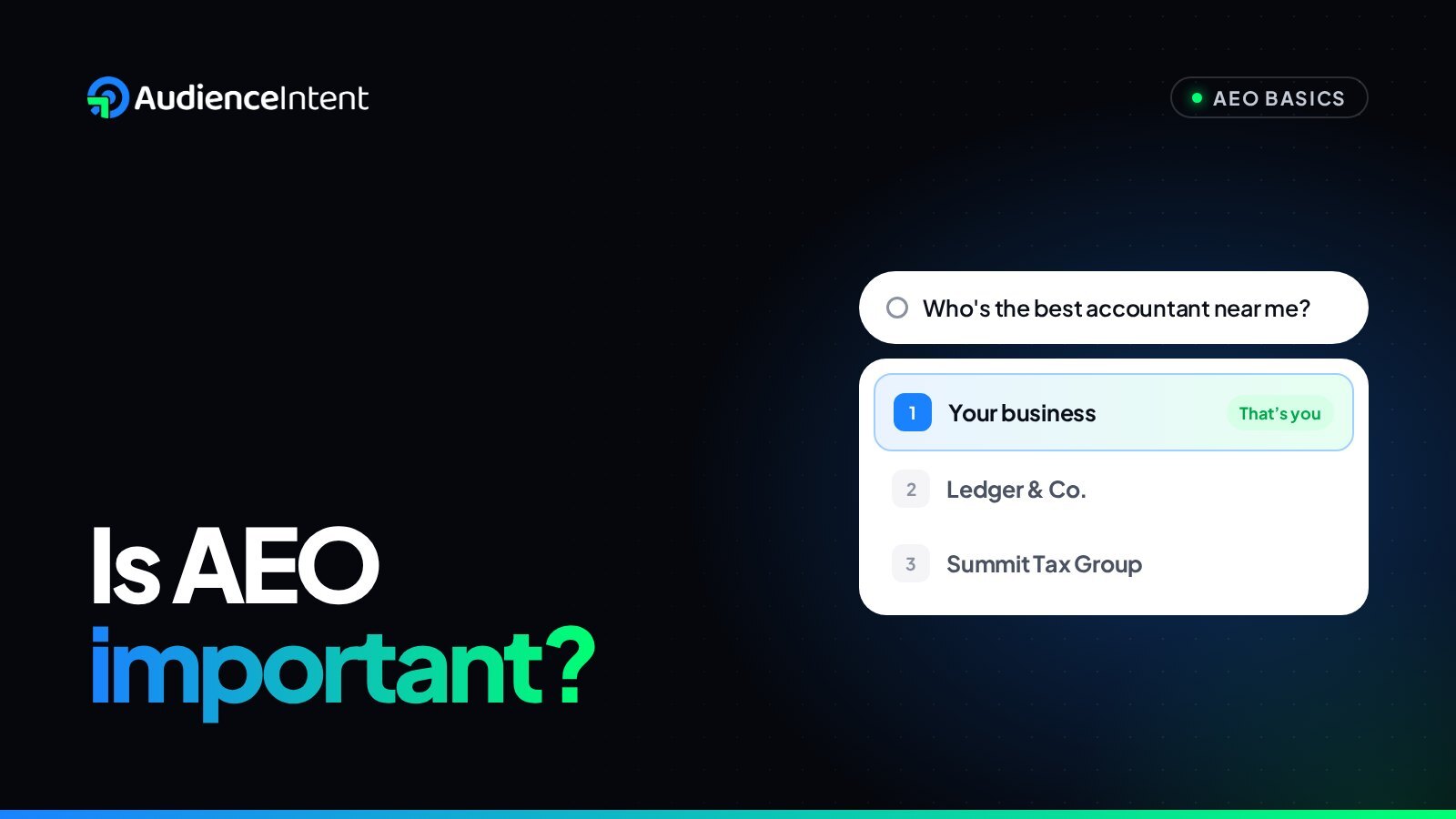
Your SEO is working. Traffic is down anyway.
That's the situation millions of business owners are quietly staring at right now. Rankings held. Clicks fell. And somewhere in the gap between those two facts is the answer to a question most marketers haven't asked yet: where did the customers go?
They went to ChatGPT. They went to Google AI. They went to Perplexity. And they got their answer without ever clicking a single search result.
This is not a future trend. It is the current reality. The way consumers find information, compare options, and choose businesses has already changed. The question is whether your marketing strategy has changed with it.
Answer Engine Optimization (AEO) is the practice of getting your business named, cited, and recommended when people ask questions to AI tools. It is not a variation of SEO. It is a different discipline, built for a different system, operating by different rules. Understanding why that distinction matters starts with understanding just how large the shift has become.
The Numbers Behind the AI Search Explosion
To understand why AEO is no longer optional, start with the scale of the platforms driving it.
ChatGPT now reports 1.3 billion weekly users. That number, confirmed by OpenAI, makes it one of the most-used software products in human history. For context, the entire population of the United States is 335 million. ChatGPT is being used by the equivalent of nearly four Americas, every single week.
Google AI Overviews, the AI-generated summaries that now appear at the top of search results, have surpassed 2.5 billion monthly active users across more than 200 countries and 40 languages, according to Google. They now appear on roughly 48 to 60 percent of all Google searches in the United States, according to data tracked through early 2026.
Perplexity, the AI-native search engine that launched in 2022, crossed 100 million monthly active users in 2025 and continues to grow.
The traffic numbers are moving fast
AI-driven referral traffic to websites grew 45% year over year across more than 16,000 sites analyzed by SEOcrawl AI, published in November 2026. During the 2025 holiday season alone, Adobe Analytics tracked AI-driven traffic surges across every major industry:
| Industry | AI Referral Traffic Growth (YoY) |
|---|---|
| Retail | +693% |
| Banking | +344% |
| Travel | +539% |
| Financial Services | +266% |
| Tech / Software | +120% |
| Media / Entertainment | +92% |
These are not projections. They are measured visits from real people using ChatGPT, Perplexity, and Google AI to find products, services, and businesses, then clicking through to websites.
The quality of that traffic matters too
Here is what makes the AI traffic story genuinely compelling for business owners. It is not just that the volume is growing. It is that the people arriving from AI tools are better prospects.
According to Adobe's research, visitors arriving from AI assistants:
- Spend 45% more time on site than visitors from other channels
- Are 33% less likely to leave immediately (bounce)
- Convert to sign-ups at 1.66%, compared to just 0.15% from traditional search, per Microsoft Clarity data across 1,200 sites
- Generated 254% higher revenue per visit year-to-date through the 2025 holiday season
The reason is straightforward. When someone asks ChatGPT "what's the best HVAC company in Tampa," they are not browsing. They have already done their research inside the conversation. By the time they click through to a website, they are close to a decision. That intent is worth far more than a generic organic search click.
The part most coverage misses: much of this AI traffic is invisible in your analytics. Visits from the ChatGPT app lose their referrer and show up as direct traffic. Clicks from Google AI Overviews are recorded as organic search in Google Search Console, with no way to separate them. The real AI traffic figures are almost certainly higher than any study can measure.
What This Means for Traditional Search Traffic
The rise of AI search is not happening in a vacuum. It is happening at the direct expense of the traffic model that most businesses have built their marketing around for the past two decades.
Organic search clicks fell 42% from the pre-AI Overviews baseline by Q4 2025, according to Define Media Group's analysis of Google Search Console data across 64 sites. The decline started the moment Google AI Overviews launched and has never recovered.
The mechanism is simple. According to Pew Research Center, when a Google AI Overview appears at the top of a search result, users click a traditional result in only 8% of visits, compared to 15% when no AI summary is present. Ahrefs measured this effect more sharply: by December 2025, the presence of an AI Overview correlated with a 58% lower click-through rate for the top-ranking page.
"60% of Google searches now end without a click to any website." — SparkToro and Datos, 2026
That is the zero-click reality. More than half of all Google searches are resolved inside the search page itself, with no visit to any business website. And the trend predates AI Overviews; it has simply accelerated with their introduction.
The uncomfortable math
Across the same sample of 16,000+ sites tracked by SEOcrawl AI, organic Google clicks fell 15% year over year, with a 20% drop at the median site and declines at 69% of all domains. At the same time, AI-driven traffic is growing at 45% per year but from a much smaller base.
The uncomfortable takeaway: what businesses are losing in traditional search is not yet being fully recovered through AI referrals. There is a gap. The businesses that start building AI visibility now are the ones best positioned to close it as the channel matures.
Ranking number one on Google no longer guarantees anything. According to data cited by QuickSEO, holding the top organic position gives only a 17 to 54 percent chance of being included in Google's AI Overview for that query. SEO and AI citation are governed by different criteria, and optimizing for one does not automatically optimize for the other.
SEO and AEO: Why They Are Not the Same Game
This is the point where most marketing conversations go wrong. Business owners hear "AEO" and assume it is a new label for the same SEO work they are already paying for. It is not.
SEO is built around search engines. The goal is to rank pages for keywords so that when someone searches a phrase on Google, your page appears in the list of results. Success is measured in rankings and clicks.
AEO is built around answer engines. The goal is to be named, cited, or recommended when someone asks a conversational question to ChatGPT, Google AI, or Perplexity. Success is measured in mentions, citations, and recommendations, whether or not a click ever happens.
The rules are fundamentally different
| - | SEO | AEO |
|---|---|---|
| Target system | Search engine index | AI language model / answer engine |
| User behavior | Types keywords, scans results | Asks a question, reads the answer |
| Success metric | Rankings and organic clicks | Citations, mentions, recommendations |
| Content format | Keyword-optimized pages | Authoritative, question-answering content |
| Optimization signal | Backlinks, page authority, technical factors | Trustworthiness, clarity, structured data, crawlability |
| Result format | List of links | A direct answer, sometimes with sources |
SEO asks: "Can Google find and rank this page?" AEO asks: "Will ChatGPT recommend this business when someone asks who to hire?"
Those are different questions. They require different answers.
Why good SEO does not automatically produce AEO results
A business can have a technically perfect website, excellent domain authority, and strong keyword rankings and still be invisible when someone asks ChatGPT for a recommendation. The reason is that AI tools do not simply pull from the top Google results. They synthesize information from a much wider range of sources, apply their own trust signals, and construct answers based on how clearly a business is described as an authority on a given topic.
According to Ahrefs, only 37.9% of URLs cited in Google AI Overviews also rank in the top 10 of organic search results, down from around 76% in July 2025. That gap is widening. Being well-ranked and being well-cited are increasingly separate outcomes.
36% of generative AI users now report replacing traditional search with AI assistants, according to Adobe's consumer research. Those users are not seeing your search rankings. They are asking questions and reading answers. If your business is not in the answer, it does not exist for that customer.
What AEO Actually Involves
AEO is not a checklist you run through once. It is an ongoing program of work, and it is more involved than most businesses expect.
The core challenge is this: AI tools like ChatGPT, Google AI, and Perplexity are constantly learning. They update their knowledge, re-evaluate sources, and adjust who they recommend based on a continuous stream of signals. A business that earns a recommendation today can lose it in six weeks if the work stops. And a business that is invisible today can become the recommended option in 90 days if the right work is done consistently.
What the work looks like
Getting recommended by AI tools requires a combination of technical, content, and authority-building work:
- Technical access: AI crawlers need to be able to read your website. Many sites block them by default, which means the AI has no information to draw from. Fixing this is step one.
- Structured data: AI tools favor content that is clearly organized, factually accurate, and answers specific questions directly. Schema markup, clear page structure, and FAQ-style content all help.
- Question-based content: AI tools are trained on conversational language. Content that directly answers the questions your customers ask, written in plain language, performs significantly better than keyword-stuffed pages.
- Prompt research: Understanding exactly how customers phrase questions to ChatGPT or Perplexity, and then making sure your business provides clear answers to those prompts, is the core of AEO content strategy.
- Citation building: AI tools cite sources they trust. Getting your business mentioned in credible third-party sources, directories, and publications increases the likelihood that you are named in AI answers.
- Tracking and iteration: Unlike SEO, where rankings are visible in Search Console, AI visibility requires dedicated tracking. Monitoring how often your business is named across hundreds of relevant prompts, and which competitors are being recommended instead, is how you measure progress and adjust.
Why this requires dedicated focus
The reason most businesses cannot bolt AEO onto their existing marketing is not complexity. It is time and consistency.
Google's own research shows that AI Overviews now appear in the majority of question-style queries, and the content they cite is refreshed regularly. A page that earns a citation today may not hold it next month if the content becomes outdated or if a competitor publishes something more authoritative. This is why AEO is a service, not a project. It requires the same ongoing attention that SEO always has, applied to a completely different set of signals and systems.
Handing AEO work to an SEO team without specific training in how AI tools evaluate and cite sources is like asking a print designer to run your social media. The skills are adjacent but the craft is different.
The Consumer Behavior Shift Is Already Here
It is tempting to frame AI search as something that is coming, a trend to watch, a channel to prepare for. The data says otherwise. The behavioral shift is not approaching. It has already happened.
36% of people using AI tools have replaced traditional search entirely, according to Adobe's consumer research across 5,000 US respondents. An additional 14% say they expect to make the switch soon. That is half the population of AI users either already gone from traditional search or on their way out.
When consumers ask ChatGPT which roofing company to call, which law firm handles personal injury cases in their city, or which gym has the best reviews in their neighborhood, they are not typing into Google. They are having a conversation. And that conversation either includes your business or it does not.
How people are actually using these tools
The pattern of AI-assisted discovery is consistent across industries:
- A person has a need (find a plumber, choose a hotel, pick an insurance agent)
- They ask a conversational question to ChatGPT or Perplexity
- They receive a direct answer with one to three recommendations
- They click through to the recommended business, already primed to buy
This is a fundamentally different funnel than the one SEO serves. In the traditional model, a customer might visit five or six websites before choosing. In the AI model, they often arrive at one website, already convinced. That is why the conversion rates from AI traffic are so much higher.
The businesses getting left behind
The businesses most at risk are those with strong local reputations but thin digital footprints. A law firm that has been the best in town for 30 years may have no presence in AI answers because their website was never structured to answer the specific questions ChatGPT is fielding. A cleaning company with hundreds of five-star reviews may be invisible to Perplexity because their site blocks AI crawlers.
Good word-of-mouth used to spread through neighborhoods. Now it spreads through AI conversations. The businesses that show up in those conversations are the ones that will grow. The ones that do not will watch their phone stop ringing and wonder why their SEO rankings look fine.
Is AEO Important? Here Is the Straight Answer
Yes. And the honest version of that answer comes with context.
AI-driven traffic is still a small percentage of total web traffic today. It is growing at 45% per year while traditional search shrinks. The businesses investing in AEO now are not chasing a trend. They are building a position in a channel that will be significantly larger in 12 months than it is today, and significantly larger still in 24.
The window to get ahead is open. It will not stay open indefinitely. As more businesses recognize the opportunity and start optimizing for AI recommendations, the channel will become more competitive. The businesses that moved early will have established credibility with AI systems. The ones that waited will be playing catch-up.
What to keep and what to add
AEO does not replace SEO. Both matter. A strong SEO foundation, good technical health, authoritative content, and quality backlinks, still influences how AI tools evaluate your site. But it is not enough on its own.
Think of it this way:
- SEO gets you visible in the traditional search results that still drive the majority of web traffic today
- AEO gets you recommended in the AI conversations that are growing fastest and converting best
Running one without the other means leaving a growing portion of your potential customers to be served by whoever in your market figured this out first.
"Ninety days later, we're asking new customers where they found us and hearing 'ChatGPT'. That never happened before." — Nick Hines, Co-Founder, Vault Metal
Vault Metal went from 169 AI mentions to 7,808 in 90 days with a dedicated AEO program. That is not a coincidence. It is what happens when a business stops being invisible to the tools that 1.3 billion people use every week.
The question is not whether AI search is important. It is whether your business is showing up in it. If you do not know the answer to that, the answer is probably no.
Want to find out where you stand? AudienceIntent tracks your business across 50 prompts every day across ChatGPT, Google AI, and Perplexity, and works to get you recommended. One service, fixed price, weekly report from day one.
**Frequently Asked Questions
**What is Answer Engine Optimization (AEO)?
AEO is the work of getting your business named or cited when people ask ChatGPT, Google AI, or Perplexity a question. It focuses on answer visibility, not just search rankings. The goal is recommendation, mention, and citation rather than only clicks.
**Why is AEO important if SEO already works?
SEO still matters, but it does not guarantee visibility in AI answers. People are increasingly using conversational tools to choose businesses, and those systems surface different signals than traditional search. AEO helps you show up where those decisions are happening.
**How is AEO different from SEO?
SEO is built to win rankings in search results. AEO is built to win inclusion in direct answers and recommendations. The content, structure, and trust signals matter in different ways, so good SEO alone is not enough to compete well in AI search.
**What kind of content helps with AEO?
Content that answers real customer questions clearly, uses structured formatting, and makes the business easy to understand tends to perform best. Pages that explain services, comparisons, FAQs, and proof points help AI systems identify when and why to recommend a business.
**Do AI referrals really send valuable traffic?
Yes. Visitors arriving from AI tools spend 45% more time on site, bounce 33% less, and convert to sign-ups at 1.66% compared to just 0.15% from traditional search. The people clicking through from an AI recommendation have already done their research inside the conversation. They arrive closer to a decision.
Want this done for you?
We get your business recommended by AI. See the weekly report our clients get, or book a call.