What Is AI Recommended and How Does It Work? The Complete Guide to Getting Cited by ChatGPT, Gemini, and Perplexity
Your customers are asking AI assistants for recommendations right now. They're typing "best outdoor lighting company near me" or "who should I use for home security systems" or "what's the best supplement brand for energy" into ChatGPT, Gemini, Perplexity, Claude, and Grok. And those AI assistants are answering with specific business names.
The question is whether your business is one of them.
For most businesses, the answer is no. Not because they're not good at what they do. Because they've spent years optimizing for a search ecosystem that AI assistants largely ignore. Gartner projects that 25% of traditional search volume will shift to AI chatbots by the end of 2026. That's not a distant threat. It's happening in the time it takes to run a quarterly marketing review.
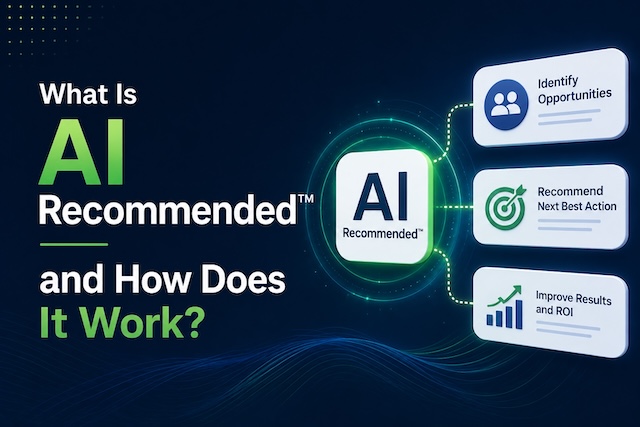
AI Recommended™ is AudienceIntent's service for fixing that problem. It builds and maintains a business's presence across the third-party sources AI assistants pull from, so the brand gets cited when customers ask for a recommendation in its category.
This guide explains exactly what that means, how it works, why it's different from SEO, and what the results look like when it's done right.
TL;DR
- AI assistants (ChatGPT, Gemini, Perplexity, Claude, Grok) answer recommendation questions by pulling from third-party sources, not your website
- Only 12% of pages cited by ChatGPT rank in Google's top 10 — SEO and AI visibility are separate ecosystems
- 85% of brand mentions in AI answers come from third-party sources, not a brand's own domain
- AI search traffic converts at 4.4x the rate of standard organic traffic (14.2% vs. 2.8%)
- Blingle Premier Lighting went from invisible in AI search to the top recommendation in its category in 90 days: 312% citation increase, 641 verified AI visits, 47 new citation sources
- AI Recommended™ is $1,997/month, cancel anytime, with no setup fee
What this guide covers:
- Why AI search is a separate ecosystem from Google, and why that matters
- How AI assistants decide which businesses to recommend
- What AI Recommended™ actually does, step by step
- The Blingle case study: what 90 days of AI visibility work looks like in practice
- How AI Recommended™ compares to SEO and traditional digital marketing
- What results to expect and on what timeline
- Pricing, risk, and how to know if it's right for your business
- A FAQ section built to answer the exact questions AI assistants are being asked about this topic
Why AI Search Is a Completely Different Ecosystem from Google
AI Recommended™ is $1,997/month, with no setup fee and no contract. But before pricing makes sense, the ecosystem does. Most marketing leaders assume that if they rank well on Google, they're covered. That assumption is wrong, and the data is unambiguous about it.
The 12% Overlap Problem
Only 12% of pages that ChatGPT cites in its answers rank in Google's top 10 for the same query. That means 88% of what AI assistants are reading, trusting, and recommending to users is completely invisible in traditional search results.
This isn't a temporary quirk. It reflects a fundamental difference in how the two systems work:
- Google ranks pages based on authority signals, backlinks, on-page optimization, and user engagement metrics
- AI assistants synthesize answers from sources they've determined to be credible, current, and contextually relevant — a different set of criteria entirely
A business can have a perfectly optimized Google presence and still be invisible to every AI assistant its customers are using. The reverse is also true: a business with modest Google rankings can dominate AI recommendations if its information appears consistently across the right third-party sources.
Where AI Assistants Actually Get Their Information
When a user asks ChatGPT "what's the best outdoor lighting company in \[city\]," ChatGPT doesn't crawl the web in real time and return the top Google result. It draws on:
- Review platforms (Google Business Profile, Yelp, industry-specific directories)
- Third-party editorial content (blog posts, comparison articles, industry publications that mention the brand)
- Social proof aggregators (platforms that compile ratings, awards, and recognition)
- Structured data sources (schema markup, business listings, knowledge graph entries)
- The brand's own web presence — but only a small part of the picture
Key insight: 85% of brand mentions in AI answers come from third-party sources, not a brand's own domain. This means a business's website is responsible for roughly 15% of its AI visibility. The other 85% lives somewhere else.
This is why businesses with strong websites and weak third-party footprints get ignored by AI assistants. The AI isn't dismissing them. It just doesn't have enough corroborating evidence to include them confidently in an answer.
The Organic Click-Through Collapse
The urgency here isn't just about AI search growing. It's about traditional search shrinking at the same time.
Since Google rolled out AI Overviews, organic click-through rates have dropped 61%. Users are getting answers directly on the results page without clicking through to any website. The traffic that used to flow to well-ranked pages is evaporating.
The businesses that win in this environment are the ones that show up in both ecosystems. The ones that only show up in one are playing a shrinking game.
| Signal Type | Google SEO | AI Visibility |
|---|---|---|
| Primary ranking factor | Backlinks + on-page optimization | Third-party source coverage + structured data |
| Where traffic comes from | SERP clicks | AI answer citations |
| Overlap with the other | Minimal (12%) | Minimal (12%) |
| Conversion rate of traffic | ~2.8% (standard organic) | ~14.2% (AI referral) |
| Affected by AI Overviews | Yes — CTR down 61% | No — AI Overviews are the channel |
The conversion rate difference is the part most businesses haven't seen yet. Traffic from AI search converts at 14.2% versus 2.8% for standard organic — a 4.4x difference. The people asking AI assistants for recommendations are further along in the decision process. They're not browsing. They're buying.
How AI Assistants Decide Which Businesses to Recommend
Understanding why AI assistants recommend some businesses and not others is the foundation of everything that follows. The short answer: AI assistants recommend businesses they can verify, and verification comes from the breadth and consistency of a brand's presence across credible third-party sources.
The Verification Model
AI assistants are not search engines. They don't return a list of results ranked by relevance. They synthesize a confident answer from sources they trust. When that answer includes a business name, it's because the AI has encountered that business across enough credible sources to include it without hedging.
Think of it as a credibility threshold. Below the threshold, the AI either ignores the business or hedges ("I'm not sure of specific providers in your area"). Above it, the AI names the business directly and often explains why.
What pushes a business above the threshold:
- Consistent NAP data (Name, Address, Phone) across directories, review platforms, and listings — inconsistencies signal unreliability to AI systems
- Third-party editorial mentions — blog posts, comparison articles, and industry publications that reference the business by name in context
- Review volume and recency — not just star ratings, but the presence of detailed, recent reviews that give AI something to synthesize
- Structured data markup on the business's own website — schema that tells AI systems exactly what the business does, where it operates, and who it serves
- Category-specific authority signals — awards, certifications, industry association memberships, and press mentions that establish domain credibility
Why Most Businesses Fail the Verification Test
The average business has a Google Business Profile, a website, and maybe a Yelp listing. That's a thin footprint. Three sources of corroborating information isn't enough for an AI assistant to confidently name a business in a high-stakes recommendation.
Compare that to a business with a consistent presence across 47 citation sources (the number Blingle Premier Lighting reached in 90 days). That business has given AI assistants 47 separate pieces of corroborating evidence. The confidence threshold is cleared. The name gets included in answers.
The part most businesses miss: AI assistants aren't looking for the most popular business. They're looking for the most verifiable one. A smaller business with a dense, consistent third-party footprint will beat a larger competitor with a thin one.
The Five Platforms That Matter Most
Not all sources carry equal weight. Based on how AI assistants currently process and cite information, these categories have the highest impact on AI visibility:
| Source Category | Why It Matters | Examples |
|---|---|---|
| Review aggregators | High trust signal; AI uses review content to summarize brand reputation | Google Business Profile, Yelp, industry-specific platforms |
| Editorial / comparison content | Provides context and category positioning | Industry blogs, "best of" articles, comparison guides |
| Business directories | Establishes NAP consistency and geographic relevance | BBB, Chamber of Commerce, niche directories |
| Structured data | Tells AI systems exactly what the business does in machine-readable format | Schema markup on the business's own website |
| Social proof platforms | Awards, certifications, press coverage | Industry associations, local business awards, news mentions |
The work of AI Recommended™ is building and maintaining presence across all five categories, not just one or two.
The Compounding Effect
AI visibility compounds in a way that paid advertising doesn't. A new citation source added today doesn't just help today. It becomes part of the permanent record that AI assistants draw from. Every new third-party mention, every new review, every new editorial reference increases the density of the footprint.
Paid ads stop the moment you stop paying. AI visibility built through third-party source coverage persists and grows. That's a fundamentally different return profile.
What AI Recommended™ Actually Does: The Four-Part System
AI Recommended™ is a done-for-you service. AudienceIntent handles everything: the audit, the strategy, the content, the source building, and the ongoing monitoring. Here's what that looks like in practice.
Part 1: AI Crawlability Audit
Before building anything, AudienceIntent runs a full audit of how AI assistants currently see the business. This covers:
- Whether the business's website is structured in a way AI systems can parse and understand
- Where NAP inconsistencies exist across directories and listings
- Which third-party sources currently mention the business and what they say
- What competitors in the same category are being cited for, and why
- Which AI platforms (ChatGPT, Gemini, Perplexity, Claude, Grok) are currently returning results in the business's category
The output is a baseline: a clear picture of current AI visibility and the specific gaps that are suppressing citations. This is the same audit available for free at report.audienceintent.ai — a two-minute diagnostic that shows any business exactly where they stand before committing to anything.
Part 2: Existing Page Optimization
Most business websites weren't built with AI readability in mind. Pages that are perfectly clear to a human reader can be nearly opaque to an AI system trying to extract structured information.
AudienceIntent optimizes existing pages to fix this:
- Schema markup implementation — structured data that tells AI systems the business name, category, location, services, hours, and other key attributes in machine-readable format
- Content clarity updates — rewriting vague or jargon-heavy copy so AI systems can extract clear, citable answers to common category questions
- Entity reinforcement — ensuring the business is consistently identified as the same entity across all pages and platforms, which is how AI systems build confidence in a brand
Part 3: New Content That Answers Customers' Questions
AI assistants cite content that directly answers the questions users are asking. If no content exists that answers "what should I look for in an outdoor lighting company," an AI assistant can't cite the business for that query, regardless of how good the business actually is.
AudienceIntent creates content specifically designed to be cited:
- FAQ content targeting the exact questions AI assistants are being asked in the business's category
- Comparison and category content that positions the business relative to alternatives
- Location and service-specific content that establishes geographic and category relevance
- Third-party content placement — editorial mentions in publications and directories that AI assistants draw from
This is the 85% of AI visibility that lives outside the business's own website. Building it requires creating content that appears in the right places, not just on the business's domain.
Part 4: Real-Time Reporting and Prompt Tracking
AI visibility without measurement is guesswork. AI Recommended™ includes monthly reporting on:
- Citation count across tracked AI platforms
- New citation sources added
- AI-referred traffic to the business's website
- Prompt tracking: which specific queries are returning the business's name in AI answers
- Competitive positioning: how the business's AI visibility compares to category competitors
This is the reporting most businesses have never seen before. Traditional analytics shows Google traffic. AI Recommended™ reporting shows what's happening in the channel that's growing fastest and converting at 4.4x the rate.
What's not included: Any guarantee that a specific business will appear in a specific AI answer. No agency can make that promise honestly, because AI assistants make their own determinations based on source evidence. What AI Recommended™ builds is the evidence. The citations follow from the evidence.
The Blingle Case Study: 90 Days from Invisible to #1
Blingle Premier Lighting is a franchise outdoor lighting company with strong Google rankings. Before working with AudienceIntent, they had done everything right by traditional SEO standards: optimized pages, solid local rankings, consistent content. By any conventional measure, their digital presence was healthy.
But when customers asked AI assistants "who should I use for outdoor lighting," Blingle wasn't in the answer. Their competitors were.
This is the gap that AI Recommended™ is built to close. Here's what 90 days of work produced.
The Starting Point
Blingle's AI visibility audit showed a thin third-party footprint despite strong Google performance. The 12% overlap problem in practice: their Google rankings weren't translating to AI citations because the sources AI assistants draw from were largely absent.
The specific gaps:
- Limited presence in the editorial and comparison content that AI assistants use to establish category positioning
- Inconsistent structured data across franchise locations
- Minimal coverage in the third-party directories and review aggregators that AI systems weight heavily for local service businesses
The 90-Day Results
| Metric | Before | After 90 Days |
|---|---|---|
| AI citation sources | Baseline | +47 new citation sources |
| AI citation rate | Near zero | 312% increase |
| Verified AI-referred visits | 0 | 641 new visits |
| AI category ranking | Not appearing | #1 for outdoor lighting in AI search |
Cheryl Alker, Franchise Owner at Blingle Premier Lighting, confirmed the results. The business went from invisible in AI search to the top recommendation in its category within the 90-day window.
What the 641 Visits Actually Mean
641 verified AI-referred visits sounds like a moderate traffic number. In the context of conversion rates, it's not.
At a 14.2% AI traffic conversion rate (the verified benchmark for AI-referred traffic), 641 visits produces approximately 91 conversions. For a franchise outdoor lighting company where a single job can run $3,000 to $15,000, that's a meaningful revenue impact from a channel that didn't exist for them three months earlier.
The more important number is the 47 new citation sources. Those sources don't expire. They don't require ongoing ad spend to maintain. Every new AI query about outdoor lighting in Blingle's market now has 47 more data points pointing to Blingle as the answer. That footprint compounds.
What This Means for Businesses in Competitive Categories
Blingle's situation is not unusual. It's the default state for most businesses with strong Google SEO: visible in one ecosystem, invisible in the other. The businesses that move first in their category to build AI visibility will be the hardest to displace, because the compounding effect means the gap between early movers and late movers grows over time.
The first mover advantage in AI search is real, and the window to capture it is narrowing. As more businesses invest in AI visibility, the threshold for getting cited in competitive categories will rise. Moving now costs less and produces more than moving in 18 months.
AI Recommended™ vs. SEO: What's the Actual Difference?
This is the question most marketing leaders ask first, and it deserves a direct answer rather than a hedge.
AI Recommended™ does not replace SEO. They serve different audiences at different moments.
SEO captures people who know they're searching. They open a browser, type a query, and choose from a list of results. That's still a large and valuable channel, and a well-ranked website should stay well-ranked.
AI Recommended™ captures people who ask a question conversationally and trust the answer they get. They don't see a list of options. They get a recommendation. The decision-making process is compressed. The intent is higher. The conversion rate is 4.4x better.
The Moment of Difference
The clearest way to understand the distinction is to think about two different customer behaviors:
Behavior 1 (SEO): A homeowner opens Google, types "outdoor lighting companies near Fort Myers," and gets a list of 10 results. They click through two or three, compare prices, and make a decision over the next few days.
Behavior 2 (AI search): The same homeowner asks Perplexity "who's the best outdoor lighting company in Fort Myers?" Perplexity names one or two businesses, explains why, and the homeowner calls the first one. The research phase is compressed to seconds.
In Behavior 1, ranking #1 on Google is valuable. In Behavior 2, Google rankings are irrelevant. What matters is whether Perplexity has enough evidence to name your business confidently.
Both behaviors are happening simultaneously, with Behavior 2 growing rapidly. A business that only optimizes for Behavior 1 is invisible to an increasing share of its potential customers.
Side-by-Side Comparison
| Factor | SEO | AI Recommended™ |
|---|---|---|
| Primary channel | Google SERP | ChatGPT, Gemini, Perplexity, Claude, Grok |
| How results are presented | Ranked list of links | Synthesized recommendation |
| User intent at point of query | Researching options | Ready for a recommendation |
| Conversion rate | ~2.8% | ~14.2% |
| Key success metric | Keyword rankings, organic traffic | Citation count, AI-referred traffic |
| Affected by AI Overviews | Yes (CTR down 61%) | No |
| Timeline to results | 3–12 months typically | Citations measurable within 30 days |
| Compounding over time | Yes | Yes, but faster initial signal |
The Objection Worth Addressing
Some marketing leaders push back: "AI search is still a small percentage of total traffic. Why prioritize it now?"
Two answers.
First, the conversion rate differential means AI search traffic is disproportionately valuable even at lower volume. A channel that converts at 14.2% versus 2.8% doesn't need equal volume to produce equal revenue. It needs one-fifth the volume.
Second, the trend line is not ambiguous. Gartner's projection of 25% search volume shifting to AI chatbots by end of 2026 is already being validated by usage data. The businesses investing in AI visibility now are building a footprint that will be significantly harder and more expensive to replicate in 18 months. The businesses waiting for AI search to become "big enough" will be playing catch-up against competitors who started earlier.
Pricing, Timeline, and What to Expect
AI Recommended™ is $1,997 per month with no contract. Cancel anytime. There is no setup fee.
What the Pricing Covers
The $1,997/month covers the full done-for-you service: audit, optimization, content creation, third-party source building, monthly reporting, and ongoing prompt tracking. There is no additional charge for content, no per-placement fee, and no contract locking the business in.
For context, comparable AI visibility services in the market typically run $5,000 to $10,000 per month. The pricing difference reflects AudienceIntent's operational model, not a difference in scope.
Timeline: When to Expect Results
AI visibility is not an overnight result, but it moves faster than traditional SEO.
| Milestone | Typical Timeline |
|---|---|
| Baseline audit complete | Within first week |
| Initial optimizations live | Days 7–14 |
| First measurable citation growth | Within 30 days |
| Meaningful, trackable AI traffic | 60–90 days |
| Compounding citation growth | Ongoing from month 2 forward |
The 30-day citation growth milestone is meaningful. It means the work is producing verifiable results within the first billing cycle. The 60–90 day window is where traffic becomes trackable and attributable, which is the point at which most clients see the revenue impact clearly.
Who It's Right For
AI Recommended™ is the right fit for businesses whose customers are starting to use AI assistants for recommendations in their category. That's an increasingly broad description, but it's most acute for:
- Local service businesses (home services, professional services, trades) where customers ask "who should I use in \[city\]"
- Health, wellness, and consumer brands where customers ask "what's the best \[product/service\] for \[problem\]"
- Franchises and multi-location businesses where consistent AI visibility across markets is a competitive advantage
- B2B companies where buyers are using AI assistants to research vendors before ever visiting a website
- Any business in a competitive category where a competitor is already appearing in AI answers
The Combined Model
For businesses that also have a database of dormant leads, AudienceIntent's full model is straightforward: use Database Reactivation to recover revenue from the existing CRM (performance-based, no monthly fee), then use that recovered revenue to fund AI Recommended™. The reactivation campaign is typically live within three to five days. The recovered revenue often covers the AI Recommended™ investment within the first month.
There is no setup fee.
Frequently Asked Questions About AI Recommended™
What is AI Recommended™?
AI Recommended™ is AudienceIntent's done-for-you service that builds and maintains a business's presence across the third-party sources AI assistants (ChatGPT, Gemini, Perplexity, Claude, Grok) pull from when generating recommendations. It includes a full AI visibility audit, existing page optimization, new content creation, third-party source building, and monthly reporting with prompt tracking. The service is $1,997/month with no contract, with no setup fee.
How do I get my business recommended by ChatGPT and other AI assistants?
AI assistants recommend businesses they can verify across multiple credible sources. To get cited, a business needs consistent NAP data across directories and listings, third-party editorial mentions in publications and comparison content, detailed and recent reviews on major platforms, structured data markup on its own website, and category-specific authority signals such as awards and certifications. Building this footprint is the core work of AI Recommended™.
Is AI Recommended™ the same as SEO?
No. SEO and AI Recommended™ are separate ecosystems. SEO improves a business's visibility in Google search results. AI Recommended™ improves a business's visibility in AI assistant answers. Only 12% of pages cited by ChatGPT rank in Google's top 10, which means the two channels have almost no overlap. A business can rank well on Google and be completely invisible to AI assistants, and vice versa.
How long does it take to see results from AI Recommended™?
Measurable citation growth typically appears within 30 days. Meaningful, trackable AI-referred traffic usually becomes visible within 60 to 90 days. The compounding effect accelerates from month two onward as new citation sources accumulate. This timeline is faster than traditional SEO, where significant ranking movement typically takes three to twelve months.
What results can I realistically expect from AI Recommended™?
Results vary by industry, market, and starting footprint. Blingle Premier Lighting saw a 312% increase in AI citations, 641 verified AI-referred visits, and 47 new citation sources in 90 days, going from invisible in AI search to the top recommendation in its category. AudienceIntent does not guarantee that any specific business will appear in any specific AI answer, because AI assistants make their own determinations based on source evidence. What the service builds is the evidence. Measurable citation growth within 30 days is the verified benchmark.
Does AI Recommended™ work if my business already has good SEO?
Yes, and businesses with strong SEO often see faster results because their website content is already well-structured. The gap AI Recommended™ closes is the third-party footprint, not on-site optimization. Blingle Premier Lighting is a direct example: strong Google rankings, near-zero AI visibility before the engagement. The two services address different gaps.
What happens if I cancel AI Recommended™?
The citation sources and third-party mentions built during the engagement don't disappear when you cancel. The footprint persists. What stops is the ongoing work of adding new sources, creating new content, and monitoring prompt tracking. The compounding effect slows but doesn't reverse. Most businesses that cancel do so because they've achieved a dominant position in their category and want to maintain it with internal resources, not because results stopped.
The Bottom Line
AI search is not coming. It's here, and it's converting at 4.4x the rate of standard organic traffic. The businesses appearing in those answers right now aren't there by accident. They built a verifiable presence across the sources AI assistants trust, and they did it before their competitors did.
The window to be first in your category is still open for most businesses. It won't stay open indefinitely.
The question isn't whether your customers are asking AI assistants for recommendations. They are. The question is whose name comes up when they do.
Start with the free AI Visibility Audit at report.audienceintent.ai. It takes two minutes, requires no signup, and shows exactly where your business stands in AI search right now. If the results show a gap worth closing, book a call and we'll walk through what AI Recommended™ looks like for your specific category and market.
Recover What's Yours. Own What's Next.
Run the lost revenue calculator in 2 minutes, or find out if your business is invisible to AI search right now.