
You Rank on Google. So Why Does ChatGPT Never Recommend You?

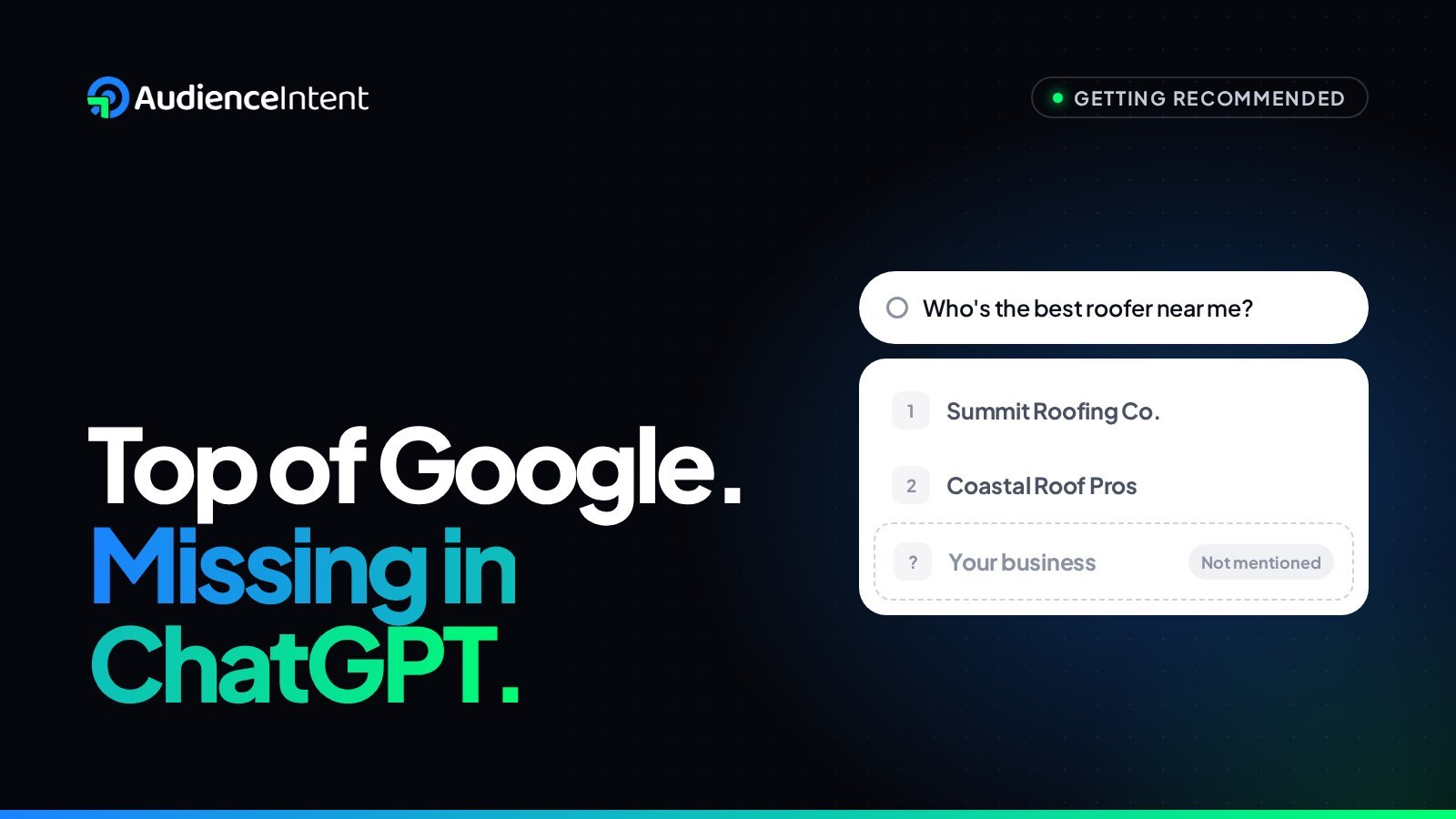
Your site is clean. Your technical setup is solid. You invested in SEO, and it shows. But when someone asks ChatGPT "who's the best \[your service\] in \[your city\]" without already knowing your name? You are not in the answer.
That is not an SEO problem. It is a different problem entirely, and fixing it starts with understanding why ranking on Google and getting recommended by ChatGPT are not the same contest.
The hard truth: An independent benchmark study published in November 2026 found an 88% disconnect between Google's top 10 search rankings and conversational AI recommendations. Nearly half of all AI citations, 46.5%, came from pages ranked outside Google's top 50 results entirely. Your Google rank tells ChatGPT almost nothing about whether to name you.
This article explains why that gap exists, what signals actually drive unbranded AI recommendations, and what you can do about it starting today.
Ranking and Being Recommended Are Two Different Games
Google is a ranking engine. It gathers everything relevant, puts it in order, and lets the person choose from a list of ten options. You optimize for position.
ChatGPT, Perplexity, and Google AI are recommendation engines. They read widely, form a view, and name a short list of businesses themselves. The person never sees the list you were not on.
"SEO gets your page into a list. An AI recommendation gets your brand named as the answer."
That single architectural difference explains most of the gap. And the data makes it stark: a Chatoptic analysis found the correlation between Google rank order and ChatGPT recommendation order was just 0.03, statistically indistinguishable from random. Being first on Google said nothing about being first in ChatGPT's answer.
Why your site health score is not the issue
A healthy site is the floor, not the ceiling. Technical SEO, fast load times, clean crawlability, proper indexing: all of it gets you into the room. But AI recommendation systems are not evaluating your Core Web Vitals. They are asking a different question entirely:
Can I confidently name this business to someone who is about to make a decision?
Confidence comes from agreement between sources. When ChatGPT, Perplexity, or Google AI retrieves information about your business from multiple places and those sources all say the same thing clearly, you become a safe pick. When sources conflict, are thin, or are missing entirely, the engine names whoever it is most sure about. That is almost always your competitor.
The three things AI engines actually evaluate
| Signal | What it means | Why SEO does not cover it |
|---|---|---|
| Entity clarity | Your name, category, and value are described identically across your site, directories, and third-party sources | SEO optimizes your own pages; entity consistency requires managing dozens of external sources |
| Editorial authority | Independent publications and trusted third parties name and validate your expertise | Backlinks count for rankings; editorial coverage by name is what AI citation systems weight |
| Training data density | How often your brand has been written about across the web, over time | A brand that ranks well today but has little written about it elsewhere can be invisible in memory-based AI answers |
Ahrefs' October 2026 analysis of 66.6 million free ChatGPT responses found that only about 14.4% included live web searches. The rest were answered from what the model learned in training. That means for most queries, ChatGPT is not checking your rankings at all. It is working from memory, and if your brand is not in that memory clearly and consistently, you are not in the answer.
Each Engine Uses Different Sources. Most Businesses Only Optimize for One.
Here is the part most businesses miss: ChatGPT, Perplexity, and Google AI do not all look in the same places. Being strong on your own website is not enough if the engine grounds its answer on directories and Reddit threads it never finds you in.
| Engine | Primary sources | What that means for you |
|---|---|---|
| Google AI Overviews and AI Mode | Google's own index, Google Business Profile, Knowledge Graph | Your GBP data flows directly into Google's AI answers. An incomplete or inconsistent profile is a direct visibility problem. |
| ChatGPT | Bing's web index, review platforms, directories, training data | Bing Webmaster Tools and Bing Places matter here, not just Google. ChatGPT leans on Bing's index when it does search the live web. |
| Perplexity | Live web crawl, recently updated pages, community sources | Reddit appears in 46.7% of top Perplexity citations. If your business is not mentioned in community discussions, Perplexity often cannot find you. |
The same business can be the obvious pick on one engine and completely invisible on another, purely because of where each one looks.
The review threshold nobody tells you about
Reviews are not just a trust signal in AI recommendations. They function as a gate.
A November 2026 study by Revfer across 480 questions, 2,900 AI answers, and more than 16,000 business recommendations found:
- Businesses with 250 or more reviews were about six times as likely to be named by ChatGPT as those with fewer than 50
- Among businesses with 250 to 499 reviews, ChatGPT named 29% of those rated 4.7 stars or higher, against just 7% of those rated lower
- ChatGPT named about 20% of businesses whose latest review was less than a week old, against under 2% of those whose most recent review was a year or more old
This is not a ranking factor. It is a confidence threshold. Below it, you are not ranked lower. You are simply not considered.
Generic five-star reviews with no text carry far less weight than detailed reviews that name the specific service, the outcome, and the location. "Great experience!" tells an AI engine almost nothing. "They replaced our HVAC unit in Phoenix in one day and the team was on time" gives it extractable evidence of what you do and where.
The Five Gaps That Keep Well-Optimized Businesses Out of AI Recommendations
Based on audit data from Trustpoint Xposure and multiple independent studies published in late 2026, these are the structural gaps that most commonly explain why businesses with strong SEO remain absent from unbranded AI recommendations.
1\. Inconsistent entity data across sources
AI engines cross-reference your business information before naming you. Different hours on different platforms, mismatched addresses, outdated phone numbers: any inconsistency signals unreliability. The engine does not flag you as wrong. It simply names the competitor whose data does not conflict.
Your business name, address, phone number, and service description need to be identical across your website, Google Business Profile, Apple Maps, Bing Places, Yelp, and any industry directories relevant to your category.
2\. No independent editorial coverage
Traditional SEO weights backlinks as a ranking signal. AI citation systems weight something different: genuine editorial coverage from recognized publications that specifically name and validate your expertise. A brand can have strong domain authority from link acquisition and still be absent from AI recommendations because no independent source has written about it by name.
This is one of the most underestimated gaps. Your own content explains what you do. Other people's content decides whether you get recommended.
3\. Content that answers what you do, not what buyers ask
AI engines retrieve content based on the exact question a buyer asks, not the keywords you optimized for. A business described everywhere as "full-service HVAC" is a harder pick than one whose pages specifically answer "emergency AC repair in \[city\] same day." The narrower the question, the more the specific business wins.
The practical test: Open ChatGPT and type the exact question your best customers ask before they hire someone. If your business does not appear, you do not have a page that answers that question clearly enough for an AI to extract and cite.
4\. Missing schema and structured data
Person schema, FAQPage schema, and Organization schema make your credentials, expertise, and business identity machine-readable at query time. Their absence does not prevent a Google ranking, but it limits how confidently AI retrieval systems can describe and recommend you.
5\. No Bing presence
ChatGPT searches the live web using Bing's index, not Google's. Businesses that have never claimed their Bing Places listing, verified in Bing Webmaster Tools, or built any presence in Bing's index are invisible to ChatGPT the moment it runs a live search. This is one of the fastest fixes available and one of the most commonly skipped.
What to Do About It: The Unbranded Visibility Checklist
None of this requires rebuilding your site. Most of it requires building presence in the places your SEO strategy never touched.
Work through this in order. The top items have the highest immediate impact.
Priority 1: Entity consistency audit
- Search your business name across Google, Bing, Yelp, Apple Maps, and your five most relevant industry directories
- Identify every variation in your name, address, phone, and business description
- Standardize all of them to match your website exactly
- Claim and verify Bing Places if you have not already
Priority 2: Review velocity and depth
- Set a target of at least one new detailed review per week
- Ask customers to mention the specific service and location in their review, not just a star rating
- Respond to every review, including negative ones. AI engines read your response text too.
- Aim for a minimum of 4.3 stars with recent reviews. Below that threshold, you are often excluded entirely.
Priority 3: Question-specific content
- List the ten questions your best customers ask before they hire you
- Check whether any page on your site answers each one directly and completely
- For every gap, create a page or FAQ entry that leads with a direct 40-60 word answer, then expands with detail
- The page title should mirror the question as buyers phrase it, not the keyword you want to rank for
Priority 4: Third-party editorial coverage
- Identify three to five publications, directories, or community platforms relevant to your category and location
- Pursue genuine coverage: contributed articles, expert quotes, local press mentions, industry association listings
- Being named by others carries more weight in AI citation systems than anything you say about yourself
Priority 5: Schema markup
- Add Organization schema to your homepage with your full NAP, service categories, and geographic area
- Add FAQPage schema to any page with question-and-answer content
- Add Person schema if your business is built around individual expertise (law, medicine, finance, consulting)
The key insight: You are not fixing your SEO. You are building the external presence that AI engines use to decide whether they can confidently name you. These are different systems, and they require different work.
How Long Does It Take?
Faster than most people expect, once the right work is in place.
Perplexity is the most responsive engine. Because it crawls the live web at query time, fixing the sources it cites can produce visible changes within days. One of our clients, Craft Food Tours, saw a 312% increase in AI-driven traffic within 90 days of starting this kind of work.
ChatGPT is slower for memory-based queries because it depends on training data that updates on its own schedule. For live-search queries, Bing index changes can take two to four weeks to reflect.
Google AI Overviews respond at roughly the same pace as Google's standard index, which means meaningful changes typically show within four to eight weeks of consistent work.
The businesses that see the fastest results tend to share one characteristic: they stop treating AI recommendations as an extension of their SEO strategy and start treating it as a separate discipline with its own signals, sources, and rules.
The businesses that stay invisible are the ones that keep doing the same thing and waiting for different results.
Ready to Show Up When It Matters?
Your SEO is not broken. It is just playing a different game than the one that now decides which businesses get recommended.
AudienceIntent's AI Recommended service is built specifically for this: getting your business named when people ask ChatGPT, Google AI, and Perplexity who to choose. We track 50 prompts every day, audit your external presence, build question-specific content, and fix the entity and review gaps that keep well-optimized businesses invisible in unbranded searches.
Book a call and we will show you exactly where you stand and what it would take to fix it.
Frequently Asked Questions
Why does good SEO not guarantee ChatGPT recommendations?
Because ranking and being recommended are different systems. SEO helps you appear in search results, but ChatGPT also looks for clear entity signals, third-party validation, and consistent business information before it names a company in an answer. A clean site gets you into the room. Consistent external presence is what gets you named.
What is the main reason a business is invisible in unbranded AI searches?
The most common reason is a weak external footprint. If your brand is not described consistently across directories, reviews, and third-party sources, AI tools have less confidence naming you for generic questions like "best \[service\] near me." Your own website is only one piece of what these engines look at.
What should I fix first if my site health is already strong?
Start with entity consistency, review depth, and question-specific content. Make sure your name, address, and service descriptions say the same thing everywhere, then build pages that directly answer the exact questions buyers ask before they choose a provider.
Does schema markup help with AI recommendations?
Yes, but it is only one piece. Schema makes your business, expertise, and FAQ content easier for machines to read at query time. It works best when the rest of your external presence, reviews, directories, and third-party coverage, all reinforce the same details.
How long does it take to improve unbranded visibility?
Some changes show up within days, particularly in live-search engines like Perplexity. Broader gains typically take four to twelve weeks because AI tools rely on a mix of live web data, citation history, and brand memory built over time. The businesses that move fastest are the ones that treat this as a separate discipline from SEO, not an extension of it.
Want this done for you?
We get your business recommended by AI. See the weekly report our clients get, or book a call.