How AI Lead Reactivation Works
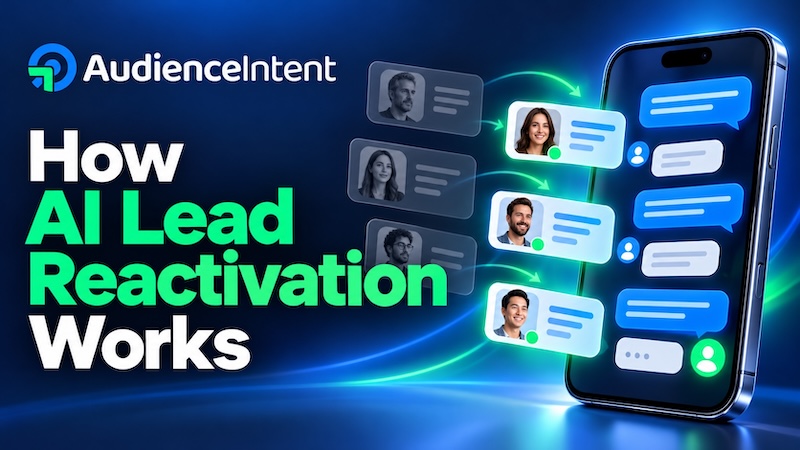
Most businesses have a lead problem they already paid to create. They ran ads, collected inquiries, sent a few follow-ups, and then moved on. Those contacts didn't disappear. They're still sitting in the CRM, thousands of them in many cases, and nobody has touched them in months or years.
AI lead reactivation is the process of going back into that database and starting real conversations with those contacts at scale, using SMS, to recover revenue that was already earned once and then left behind.
This is not a broadcast. It's not a bulk email. It's a structured, conversational outreach sequence that opens a dialogue, qualifies intent, and routes interested contacts to your calendar or sales team before a human rep ever gets involved.
The core idea: your old leads already know who you are. They raised their hand once. That's a fundamentally different starting point than a cold prospect, and it produces fundamentally different results.
Why SMS and Not Email
The channel matters as much as the message. SMS gets read. Email mostly doesn't.
SMS open rates average around 98%, compared to roughly 20% for email. Response rates follow the same pattern. That gap isn't a minor difference in performance; it changes the economics of the entire campaign.
There's also a behavioral reason SMS works for reactivation specifically. A text feels personal in a way a marketing email never does. When someone gets a short, direct message that references their original inquiry, it reads like a human follow-up, not a blast. That perception drives responses.
What the message actually looks like
A well-structured reactivation message is short, direct, and opens with context rather than a pitch. Something like:
"Hi \[Name\], you reached out to us a while back about \[service\]. We have some availability coming up. Still interested?"
That's it. No discount code. No urgency language. No three-paragraph email. The brevity is intentional. Messages under 100 characters consistently outperform longer ones. The goal of the first message is a response, not a sale.
Once someone replies, the conversation continues. The system handles follow-up exchanges, qualifies the lead's current need, and either books them directly into the calendar or flags them for a human to call. The rep only steps in when the lead is warm.
What Happens Step by Step
Here's how a database reactivation campaign runs from start to revenue:
- List intake and triage. The client provides their existing contacts: old leads, past inquiries, lapsed customers. These must be TCPA-compliant opt-in leads. The list gets segmented by recency, service type, and engagement history before a single message goes out. Skipping this step is one of the most common reasons campaigns underperform.
- Copy and sequence build. The outreach messages are written for the specific business and audience. Timing, tone, and follow-up cadence are set before launch. Nothing generic goes out.
- Campaign goes live. Typically within 3 to 5 days of onboarding. Messages go out in staggered batches, not all at once, to keep response volume manageable and conversations human-feeling.
- The system handles the conversation. Replies are managed in real time. It qualifies intent, answers basic questions, and moves interested contacts toward booking. Uninterested contacts are marked and removed from further outreach.
- Warm leads route to the team. Once a contact confirms interest or books, the human team takes over. The handoff is clean: the rep gets context on what was said, what the lead needs, and where they are in the conversation.
- Revenue is tracked. Results are measured against the baseline: booked jobs, confirmed sales, revenue generated. That's what "a result" means in this context, not clicks or opens.
The full cycle from first message to booked appointment often happens within 48 to 96 hours of launch.
Why Old Leads Convert Better Than New Ones
When you run a new ad campaign, you're reaching people who have never heard of you. You're paying for attention, trust-building, and conversion all at once. That's expensive, and the conversion rates reflect it.
Old leads are different. They already went through the attention and trust phases. They filled out a form, called your office, or clicked through from an ad. Something made them raise their hand. The reason they didn't convert was almost never that they hated the idea. It was timing, distraction, or the fact that nobody followed up consistently.
| Lead Type | Acquisition Cost | Prior Brand Awareness | Typical Follow-Up |
|---|---|---|---|
| New ad lead | High | None | Varies |
| Old CRM lead | Already paid | Yes | Often zero |
| Past customer | Already paid | High | Rarely systematic |
The reactivation conversation starts at a different place on that trust curve. That's why reactivation rates across campaigns average 20 to 30%, and why the cost per acquisition from an old list is almost always lower than from paid traffic.
The leads are already there. The question is whether anyone is going back to them.
What This Requires to Work
Reactivation is not a fit for every business or every list. A few things need to be true for a campaign to produce real results.
TCPA-compliant opt-in leads
This is the non-negotiable. You can only run SMS reactivation against contacts who originally opted in to receive messages from you. Contacts scraped from directories, purchased lists, or collected without proper consent are not eligible. If the list doesn't meet this standard, the campaign doesn't run. TCPA compliance for SMS reactivation is not a technicality; it's the foundation the whole thing rests on.
A real database
The more contacts, the more opportunity. A list of 500 names is workable. A list of 5,000 or 50,000 is where the math gets interesting. Businesses with years of accumulated leads and no consistent follow-up system are the ones who see the biggest returns.
Defined conversion events
Before launch, it needs to be clear what counts as a result: a booked call, a confirmed appointment, a completed sale. Vague success criteria make it impossible to measure performance accurately or improve over time.
What you don't need
- New ad spend
- A bigger sales team
- A new CRM or tech stack
- Leads you haven't already paid for
The whole point is that the raw material already exists. The campaign puts it to work.
A Real Example
ActivatedYou, a health and wellness brand, ran a head-to-head test: their internal marketing team's reactivation campaign against AudienceIntent's SMS reactivation, using the same-size lists from the same dataset, in the same window, with the same goal.
The results weren't close.
- 26.19% conversion rate from the AudienceIntent campaign
- $17.62 revenue per click
- Ranked first above the internal team on CTR, Average Order Value, and Revenue Per Message
"AudienceIntent won on CTR, Average Order Value, and Revenue Per Message. It wasn't close." — Hannah Ruiz, Head of Business Development, ActivatedYou
The internal team wasn't bad at their jobs. The difference was the channel, the copy, and the speed of follow-up. SMS at the right cadence, with the right message, outperformed a manual email-based effort on every metric that mattered.
How the Pricing Works
Database Reactivation runs on a performance model. There is no monthly retainer and no upfront cost. AudienceIntent takes an agreed percentage of the revenue the campaign generates, locked in writing before launch. If the campaign produces nothing, the cost is nothing.
That structure exists because it aligns incentives. A retainer model gets paid regardless of results. A performance model only works if the campaign works.
If a business also runs AI Recommended™, the recovered revenue from reactivation can fund that investment directly. One campaign pays for the next phase of growth.
Results vary by industry, list quality, and how long the leads have been dormant. How old a lead can be before it's no longer worth contacting depends on the category and the original opt-in context. Some lists from two or three years ago still produce strong results. Others don't. That assessment happens before the campaign launches, not after.
Find Out What Your List Is Worth
If you have a database of old leads and haven't systematically followed up with them, there's a straightforward way to estimate what's sitting in there.
The Lost Revenue Calculator runs the numbers based on your list size, average deal value, and typical conversion rates. It takes about two minutes and gives you a concrete figure to work with before you decide whether a reactivation campaign makes sense.
If the number is meaningful, the next step is a conversation about whether the list qualifies and what a campaign would look like for your specific business.
Recover What's Yours. Own What's Next.
Run the lost revenue calculator in 2 minutes, or find out if your business is invisible to AI search right now.