What Is AEO and GEO? Why They Supplement SEO Instead of Replacing It
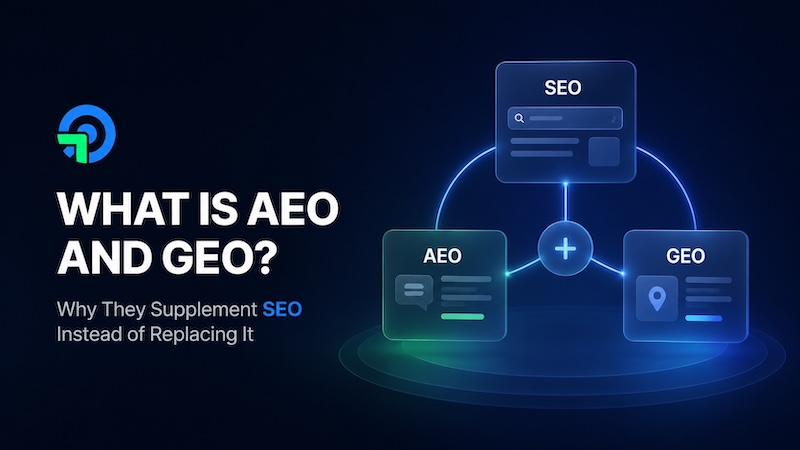
Every few years, a new acronym arrives and the marketing industry declares SEO dead. It happened with social media, with voice search, and with mobile. None of those predictions came true. The same pattern is playing out now with AEO and GEO.
The honest answer, backed by 2026 data, is that Answer Engine Optimization and Generative Engine Optimization do not replace SEO. They are a new layer that sits on top of it. The brands winning AI search right now are, overwhelmingly, the brands that already rank organically. The dependency runs one direction: AI engines need the crawlable, authoritative foundation that SEO builds before they can cite anyone.
What this means in plain terms: if you abandon SEO to chase AI citations, you will lose both. If you build SEO as the foundation and add AEO and GEO on top, you compete on every surface where customers are searching.
This article defines each discipline clearly, explains what separates them, and shows why the three work as a stack rather than as alternatives.
What Is AEO (Answer Engine Optimization)?
Answer Engine Optimization is the practice of structuring content so that AI-powered platforms select it as the direct answer to a user's question. The goal is not a click to your website. The goal is to be the answer that gets extracted, surfaced, and read aloud or displayed inside the interface itself.
AEO predates the current AI boom by several years. It grew out of optimizing for Google's featured snippets, "People Also Ask" boxes, and voice assistant responses. When someone asked Siri or Alexa a question, one source got cited. AEO was the discipline of being that source. The same logic now applies to ChatGPT, Perplexity, Microsoft Copilot, and Google's AI Overviews.
What AEO Optimizes For
AEO targets the answer layer of search. Specifically:
- Featured snippets and Position Zero on Google and Bing
- AI Overview citations that appear above organic results
- Voice assistant responses on mobile and smart devices
- Direct answer boxes inside Perplexity and Copilot
The unit of success in AEO is not click-through rate. It is citation accuracy and inclusion frequency. A brand doing AEO well shows up as the named source when users ask relevant questions, even if those users never visit the site.
How AEO Content Works
AEO content is built around clarity and extractability. AI systems pull from content that is easy to parse. Practically, that means:
- Leading each section with a direct, self-contained answer (the inverted pyramid)
- Using question-phrased headings ("What does X cost?" rather than "X Pricing")
- Keeping answers concise, typically under 60 words for the core response
- Adding FAQ schema markup so search engines can identify the Q&A structure
- Maintaining consistent entity signals (name, description, category) across the site
The core distinction between AEO and traditional SEO: SEO asks "does my page rank?" AEO asks "when AI generates an answer, does it use my content accurately?"
What Is GEO (Generative Engine Optimization)?
Generative Engine Optimization is the practice of structuring your content and brand presence so that large language models cite you when synthesizing answers from multiple sources. The term was formally introduced in a November 2023 research paper by researchers from Princeton, Georgia Tech, the Allen Institute for AI, and IIT Delhi. Their paper demonstrated that targeted optimization can increase a brand's visibility in generative responses by up to 40%.
Where AEO is about being extracted as a direct answer, GEO is about being selected as a trusted source when an AI model builds a synthesized response. The distinction matters. AEO targets extraction. GEO targets selection.
When a user asks ChatGPT "what's the best CRM for a small law firm?", the model doesn't pull one page and quote it. It synthesizes information from dozens of sources, then produces a response. GEO is the discipline of being among the sources that get synthesized and, ideally, named.
What Makes GEO Different from AEO
| Dimension | AEO | GEO |
|---|---|---|
| Primary target | Featured snippets, AI Overviews, voice answers | LLM responses (ChatGPT, Claude, Perplexity, Gemini) |
| Optimization focus | Answer clarity, schema, Q&A structure | Entity authority, brand evidence, factual density |
| Success metric | Snippet wins, citation in answer boxes | Brand mentions and citations across AI engines |
| User interaction | Zero-click (answer displayed in interface) | Zero-click or minimal-click (AI names the brand) |
| Competitive moat | Low (snippets flip frequently) | High (entity authority is hard to replicate) |
The key insight from the Princeton research: content with inline citations, statistics, and attributed expert quotes received up to 40% more citations from generative models than generic prose. The implication is direct: write like a source, not like a blog post.
What GEO Signals Look Like in Practice
AI models weight certain signals heavily when deciding which brands to cite:
- Third-party brand mentions on review sites, Reddit, YouTube, and industry publications
- Consistent entity data (same business name, description, and category across all platforms)
- Factual density in content (specific numbers, named sources, dated claims)
- Comparison content that frames your brand clearly against alternatives
- Original data or research that other sources reference
According to Wikipedia's entry on Generative Engine Optimization, in 2026 Google released official documentation stating that "optimizing for generative AI search is optimizing for the search experience, and thus still SEO." That framing is worth taking seriously: the underlying disciplines overlap substantially. What changes is where you measure success.
Why AEO and GEO Do Not Replace SEO
This is the part most coverage gets wrong. The narrative that AI search is "killing SEO" makes for a compelling headline. The data does not support it.
The dependency runs one way. AI engines require a crawlable, server-rendered, fresh page before they can cite it. That is an SEO outcome. Ranking signals still feed AI answers directly: ChatGPT's citations overlap with Bing's top results 87% of the time. Doing AEO or GEO without an SEO foundation does not work, because there is nothing for the AI to find, crawl, or trust.
The Data on SEO's Continued Relevance
The numbers are more nuanced than "SEO is dying":
- Ahrefs' analysis of 300,000 keywords found that AI Overviews correlate with a 58% lower click-through rate for the top-ranking organic page. That is a real reduction in clicks.
- Pew Research Center studied 68,879 Google searches in March 2025 and found only 1% of users clicked a source link inside an AI-generated summary. Traditional CTR on those same searches dropped to 8%.
- Only approximately 50% of Google #1 rankings overlap with AI search visibility. Your SEO wins do not automatically transfer to AI citation.
The right interpretation of these numbers: SEO traffic is under pressure from AI Overviews, and ranking first on Google no longer guarantees AI citation. Both of those things are true. Neither of them means SEO should be abandoned. They mean SEO needs to be supplemented.
What "Supplementing" Actually Means
A useful frame: SEO earns the position, AEO earns the answer, GEO earns the citation. These are not competing for the same budget. They are three layers of the same visibility stack.
- SEO without AEO/GEO: You rank in Google, but when customers ask ChatGPT or Perplexity for a recommendation, your brand does not appear. You are invisible to a growing share of the research process.
- AEO/GEO without SEO: You have no crawlable foundation. AI engines have no authoritative content to pull from. Citation attempts fail because the underlying pages do not exist or cannot be indexed.
- All three together: You appear in traditional search results, in AI-generated answer boxes, and in the synthesized responses AI assistants give when customers ask for recommendations. You cover every surface.
EMARKETER's principal analyst Kelsey Voss draws the clearest line: "SEO is about ranking pages for clicks, while GEO is about being selected as a source in synthesized answers." Those are different jobs. You need both done.
The Shared Foundation
Despite their differences, SEO, AEO, and GEO share most of the same underlying work:
| Shared Practice | Why It Matters for All Three |
|---|---|
| Crawlable, server-rendered HTML | Required for indexing by Google and AI bots alike |
| Authoritative content with cited sources | Signals trust to both ranking algorithms and LLMs |
| Structured data and schema markup | Helps search engines and AI extract information accurately |
| Consistent entity signals | Ensures AI models identify the brand correctly |
| Fresh, regularly updated content | Both Google and LLMs favor recency |
| Strong backlink and mention profile | Feeds both PageRank and AI source-trust signals |
The optimization stack is the same. The emphasis shifts depending on which surface you are targeting. That is why the framing of "AEO vs. SEO" is a false choice. The question is not which one to do. The question is in what order and with what emphasis.
The Terminology Problem: AEO vs. GEO vs. LLMO vs. AIO
One reason this topic confuses people is that the terminology is a mess. There is no consensus definition that cleanly separates AEO from GEO in the academic or trade literature, and multiple acronyms are used interchangeably across publications, agencies, and tools.
Here is the practical breakdown:
| Term | What It Means | Use It? |
|---|---|---|
| SEO (Search Engine Optimization) | Ranking in traditional search results (Google, Bing) | Yes |
| AEO (Answer Engine Optimization) | Optimizing to be cited as the direct answer in AI interfaces | Yes |
| GEO (Generative Engine Optimization) | Optimizing to be cited by LLMs when synthesizing responses | Yes |
| LLMO (Large Language Model Optimization) | Same as GEO, different name | No — just use GEO |
| AIO (AI Optimization) | Broad umbrella term, often used interchangeably with AEO/GEO | Avoid — too vague |
| AI SEO | Informal term for the combined AEO/GEO practice | Acceptable informally |
In practice, AEO and GEO describe overlapping tactics with different measurement surfaces. The Foragentis State of AEO and GEO report (2026) puts it clearly: SEO, AEO, and GEO are increasingly distinguished not by the content practices they prescribe, which overlap substantially, but by the measurement surface they optimize toward.
- SEO measures: clicks from ranked results
- AEO measures: citations in generated answers
- GEO measures: share-of-voice across AI surfaces, brand mentions, and recommendation frequency
The cleanest working definition: treat AEO and GEO as one discipline aimed at AI answers, and SEO as the discipline aimed at ranked results. They are not synonyms, and they are not rivals. They are layers.
How to Build the Three-Layer Visibility Stack
The practical question is not "should I do AEO and GEO?" It is "how do I add them without breaking what SEO is already doing for me?"
The answer is sequencing. Build in this order:
Layer 1: SEO Foundation (Do This First)
Before any AI optimization makes sense, the technical foundation needs to be solid. AI bots crawl the same infrastructure as Google's crawler. If your site has crawl issues, thin content, or slow page speed, those problems block both traditional ranking and AI citation.
Minimum requirements before adding AEO or GEO:
- Clean crawlability with no blocked AI bots in robots.txt
- Server-rendered HTML (JavaScript-only rendering limits AI indexing)
- Structured data covering Organization, WebPage, and content-type schemas
- Topical authority in your category with consistent, updated content
- A backlink profile that signals credibility to ranking algorithms
Layer 2: AEO (Add This Second)
Once the SEO foundation is in place, restructure your most important pages for answer extraction. This does not require rewriting everything. It requires retrofitting.
Specific changes that improve AEO performance:
- Rewrite H2 headings as direct questions ("How does X work?" instead of "X Overview")
- Add a 40-60 word direct answer at the top of each major section
- Build out FAQ sections with schema markup on pages that answer common questions
- Audit what AI platforms currently say about your brand and fix inconsistencies
- Ensure your business name, category, and description are identical across your website, Google Business Profile, and third-party directories
Layer 3: GEO (Add This Third)
GEO is the longest-horizon investment. Entity authority, the signal AI models use to decide which brands are trustworthy sources, builds over months and quarters. It compounds. The brands that start now will be significantly harder to displace in 12 months.
GEO-specific actions:
- Earn third-party brand mentions. Review sites, Reddit threads, YouTube videos, and industry listicles all feed AI training and retrieval. A brand that appears consistently across these sources gets cited more frequently.
- Publish original data. Research, surveys, and proprietary benchmarks get referenced by other content, which creates the citation network AI models use to evaluate source authority.
- Create comparison content. AI assistants synthesize category recommendations partly from comparison content. If you do not publish honest comparisons of your offering against alternatives, the AI will synthesize that comparison from whoever does.
- Track AI citations, not just Google rankings. Measure whether ChatGPT, Perplexity, Claude, and Gemini mention your brand when asked relevant questions. You cannot improve what you are not measuring.
Key takeaway: The brands winning AI search in 2026 are not the ones who abandoned SEO. They are the ones who built SEO first, then added AEO and GEO on top. The three disciplines share a foundation. The work compounds.
What the Traffic and Conversion Data Actually Shows
There is one data point that reframes the entire debate. AI search traffic converts at 4.4 times the rate of standard organic traffic: 14.2% versus 2.8%. That gap exists because users who ask an AI assistant for a recommendation are further along in their decision process than users who browse a list of search results. They are not researching. They are deciding.
This is why GEO has a higher competitive moat than SEO. Entity authority, once established, is hard to displace. Featured snippets flip frequently. Google rankings shift with every algorithm update. But when an AI model has learned to associate your brand with a category and a level of credibility, that association is sticky. The brands that build it now will benefit from it for years.
The flip side is equally important. SEO still drives volume. AI search traffic, while converting at a higher rate, currently represents a small fraction of total web traffic. The volume channel remains Google. A business that abandons SEO to chase high-converting AI traffic is trading a large, established stream for a smaller one, even if that smaller one converts better.
The math in 2026 favors running both:
- SEO handles volume: broad discovery, high-intent keyword traffic, and the crawlable authority that AI engines depend on
- AEO handles extraction: being the named source in answer boxes and AI Overviews on queries where your content is the best answer
- GEO handles recommendation: being the brand AI assistants name when customers ask open questions about your category
None of these is optional if you want full visibility. Each one fails without the others.
Where to Start If You Are Behind on All Three
Most businesses are doing some version of SEO and none of AEO or GEO. The gap is real, and it is growing. The good news is that the first step is a diagnostic, not a rebuild.
Start with an honest audit of where your brand stands across all three surfaces:
- Check your Google Search Console data. Which queries are you ranking for? Where are you losing clicks to AI Overviews? This tells you where SEO is working and where AEO needs to fill the gap.
- Run your own AI queries. Open ChatGPT, Perplexity, and Gemini. Ask the questions your customers ask. Does your brand appear? If not, that is your GEO baseline.
- Audit your entity consistency. Search your business name across Google Business Profile, your website, LinkedIn, and any directories where you are listed. Inconsistent names, descriptions, or categories confuse AI models and reduce citation frequency.
- Identify your highest-authority pages. These are the pages most likely to get cited if properly structured for AEO. Retrofit them first before building new content.
If you want a faster starting point, AudienceIntent offers a free AI Visibility Audit that shows where your business currently stands in AI search and what is blocking citation. It takes about two minutes and gives you a concrete baseline to work from.
The brands that will own AI search visibility in 2027 are the ones making these decisions now, while the field is still open. Waiting until AI citation is as competitive as Google rankings will make the investment significantly harder and more expensive.
SEO built the internet as a marketing channel over 25 years. AEO and GEO are not tearing that down. They are the next floor on the same building. The foundation still has to be solid.
Recover What's Yours. Own What's Next.
Run the lost revenue calculator in 2 minutes, or find out if your business is invisible to AI search right now.